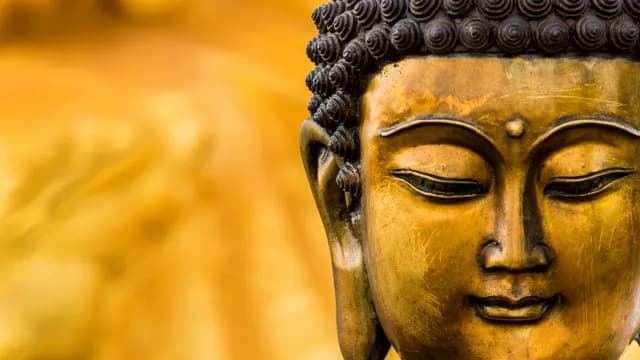
As long as they find pleasure in material things, materialists will hunt for material pleasures. Whether selfish or so-called unselfish, they will seek the dull pleasures of the material world. Material pleasures are in truth very pathetic and insignificant. They are not a good companion to spiritual things. Among the materialists those who are intelligent cannot find any satisfaction in material pleasures. Ignorant of spiritual existence, how can they search after eternal spiritual pleasures? They come to think the cessation (nirvana) of their own existence is the only happiness. To that happiness they run. They say, "Existence is suffering. Cessation of existence is happiness. Because this material body brings only sufferings, let us strive for the happiness of ceasing (nirvana) to exist."
At the time in India when the atheistic karma-mimamsa of seeking material pleasures was very prominent, and when the Vedas, which are filled with spiritual truths, were considered the only true scriptures, and when, claiming that the Vedas teach the atheistic karma-mimamsa philosophy, many materialistic brahmanas sought by performing yajnas to attain sensory pleasures in this life and apsaras and nectar in Indra's city in the next life, a certain person dissatisfied with material pleasures. A person named Sakyasimha and born in a ksatriya family, deciding one day that there was no escape from the sufferings of the material body and that true happiness rests in cessation (nirvana) of existence, founded the philosophy of Buddhism. Even before that time the same philosophy of nirvana was preached, a fact for which there is ample evidence. However, it was at the time of Sakyasimha that this philosophy found many followers. From that time on there were many preachers and followers of Buddhism. Sakyasimha was not the only preacher of Buddhism. During his time, or a little before, a person named Jina, who was born in a vaisya family, preached a philosophy much like Buddhism. His philosophy is called Jainism. Jainism remained within India. But Buddhism crossed the mountains, rivers, and oceans and entered China, Thailand, Japan, Myanmar (Burma), Ceylon, and many other countries. Even today this philosophy is followed in many countries. Buddhism has many branches. Still, the ideas of void (sunya) and of cessation of existence (nirvana) are seen in all the branches. Still, human beings cannot reject their natural belief in God, so in some branches of Buddhism worship of God is also seen.
I once asked some questions of a Buddhist monk from Myanmar, a fellow who did not understand the true teachings of Buddhism. He answered my questions by saying, "God is beginning-less. He created the entire world. Assuming the form of Buddha, He descended to this world and then, again assuming His form as God, He returned to heaven. If we act piously and follow the rules of religion, then we will go to His abode." From what he told me, I could see that this Buddhist monk from Myanmar did not know the true Buddhist philosophy. In the name of Buddhist philosophy he simply repeated the common religious ideas that are part of human nature.
Philosophy based on tricks of logic cannot bring good to human society. Such tricky philosophy is cherished only in the hearts and books of professional philosophers. The people in general who claim to follow these philosophies will tend to revert to the common religious ideas that are part of human nature. The "universal love" preached by Comte, the karma-mimamsa and imaginary apurva-God preached by Jaimini, and the cessation (nirvana) of existence preached by Sakyasimha will all gradually become transformed by their followers into the common religion that is part of human nature. That is inevitable. At this moment it is happening.
A philosophy of cessation (nirvana) of existence, a philosophy like the Buddhist and Jain philosophies, was also preached in Europe. This philosophy was called "Pessimism." Buddhism and Pessimism are not at all different. They are different in only one way. In Buddhism the soul wanders from one birth to another, always suffering. By following the principles of Buddhism the soul gradually attains nirvana (preliminary cessation of existence) and then parinirvana (final cessation of existence). In the philosophy of Pessimism the soul does not have birth after birth. Thus the philosophy of cessation of existence is of two kinds:
- cessation of existence after one birth, and
- cessation of existence after many births.
Buddhism and Jainism belong in the second group. Both accept transmigration of the soul. According to Buddhism, after many births of practicing kindness and renunciation, one becomes first a Bodhisattva and finally a Buddha. In this philosophy by practicing humbleness, peacefulness, tolerance, kindness, selflessness, meditation, renunciation, and friendliness, the soul eventually attains parinirvana. In parinirvana the soul no longer exists. In ordinary nirvana the souls continues to exist in a form of mercy.
The followers of Jainism say: "By practicing kindness and renunciation, and by cultivating all virtues, the soul gradually passes through the stages of Naradatva, Mahadevatva, Vasudevatva, Paravasudevatva, Cakravartitva, and, at the end, when he attains nirvana, Bhagavattva. Buddhism and Jainism both accept the following ideas: The material world is to be eternal. Karma has no beginning, but it does have an end. Existence is suffering, and cessation of existence (parinirvana) is happiness. Jaimini's karma-mimamsa philosophy, which claims to accept the Vedas' authority, is inauspicious for the living entitties. Cessation of existence (parinirvana) is auspicious for the living entities. Although they are masters of the followers of karma-mimamsa, Indra and the demigods are servants of the sages who seek nirvana.
Schopenhauer and Hartmann belong in the first group of philosophers who preach cessation of existence. Schopenhaur taught that by abandoning the will to live, and by fasting, desirelessness, renunciation, humbleness, bodily mortification, purity, and renunciation the soul attains nirvana. In Hartmann's philosophy there is no need for bodily mortification. At the moment of death one automatically attains nirvana. A philosopher named Harry Benson taught that suffering is eternal and nirvana an impossibility.
Here it may be said that the Advaita (Monism or Impersonalism) philosophy is only another kind of materialistic philosophy of cessation of existence. All the impersonalists yearn to end their own individual existence and then taste the spiritual bliss of merging into impersonal Brahman. That is their philosophy. However, after nirvana they no longer exist. If they do not exist, then they cannot experience bliss or anything else. Actually, their philosophy is exactly like the materialistic philosophy of nirvana. The materialistic philosophy of the cessation of existence is completely untenable, for it has not decided on the nature of the individual person. If the individual persons are merely creations of matter, then one falls into the philosophy of accepting only material pleasures as important. That is pure atheism. But if, on the other hand, the individual persons are different from matter, independent of the transformations of matter, then how will they cease to exist? Is there any evidence that non-material persons, or spirit souls, ever cease to exist?
In the end all these philosophies are complete atheism. It was to stop the wickedness of the karma-mimamsa idea that the preachers of these nirvana philosophies preached their own idea so fervently. Because of the brahmanas oppressive ways and their embracing the karma-mimamsa idea, the ksatriyas and other castes became very disturbed and staged a philosophical revolt against the brahmanas. For this reason the ksatriyas all accepted Buddhism and the vaisyas all accepted Jainism. When people divide into factions and hate each other in terms of those factional groupings, that hatred can become very strong. Passionately loyal to their faction, the people no longer give any thought to what ideas are logical or illogical. That is how Buddhism and Jainism were spread in India. They were also spread to other countries. Weak in spiritual reasoning, the people of those countries accepted those philosophies as sent by God. In Europe some people who hated Christianity also preached the philosophy of nirvana. That is revealed in history.
Excerpted from Tattva-viveka of Srila Bhaktivinoda Thakura, Text 13