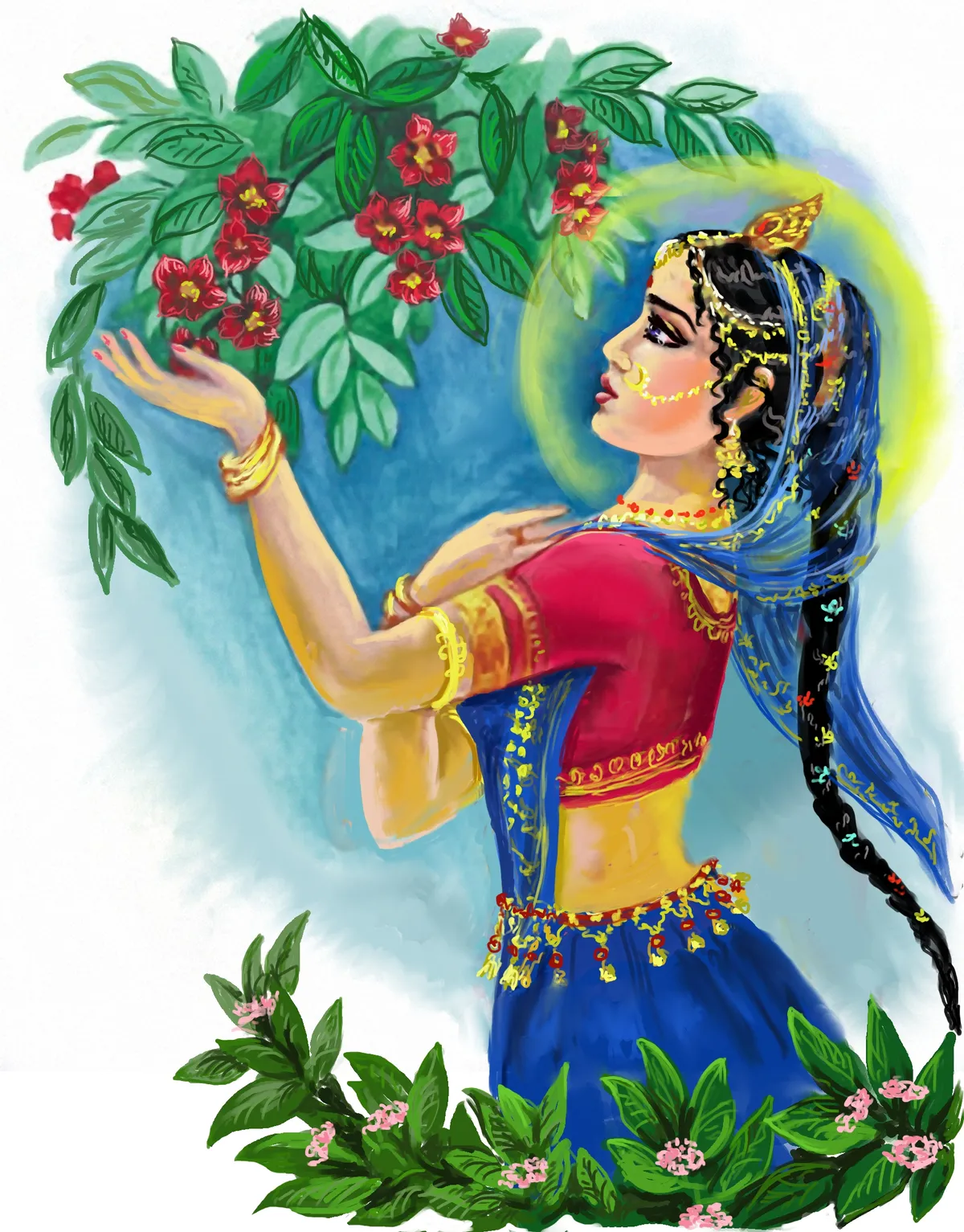
galad-vrīḍā lolā madana-vinitā gopa-vanitā mada-sphītaṁ gītaṁ kimapi madhurā cāpala-dhurā samujjṛmbhā gumbhā madhurima-kirāṁ mādṛśa-girāṁ tvayi sthāne jāte dadhati capalaṁ janma saphalam Kṛṣṇa-karṇāmṛta 101
O Kṛṣṇa, being situated in You, the following things have achieved the fruit of thier transient existences: the wives of the cowherd men who become restless, their shyness destroyed, and who turn humble with love for You; songs, which become swollen with passion; Your excess of frivolity, which becomes very sweet; and my fully elated words, which scatter sweetness by stringing a garland of verses about You.
There are many writers and poets who write so much prose and poetry with their own speculation and ideas. The writers reserve their moods in their writing. Touching this, one comes near them. In Vraja-maṇḍala, the dust, trees, creepers, plants, animals, men, and women—everything is imbued with nectar. Their hearts are full of nectar. Anything they speak is exquisite poetry and prose. To drink that nectar, Kṛṣṇa is restless and walks behind them continuously. The Vraja-devīs and Vrajavāsīs do not uselessly talk, nor do they offer their speech for the pleasure and happiness of others, or to taunt or disturb others. They reserve their words for Kṛṣṇa, and this is nectar for Him. He says, “My life is successful because the Vrajavāsīs give me some of their nectar.” Sometimes they make flower garlands, and on each flower and petal they write with kuṁkuma or sandalwood paste. In this way they express their desire to serve Kṛṣṇa. When Kṛṣṇa wears these flower garlands, He becomes very restless and answers with His flute. Which gopī collected which flower and made which garland, Kṛṣṇa realizes and answers. Then that gopī feels, “My life is successful. Kṛṣṇa understands my desire.” They cook something, and then their desire goes there. It is present with that food. They cannot explain directly. They are shy and do not open their own mouth to tell this to Kṛṣṇa. They are greater than munis and ṛṣis. Ṛṣis and munis become restless, but the gopas and gopīs remain silent and are never restless. They are always ready to act for the pleasure of Kṛṣṇa, and try for this again and again. Therefore, they are busy and don’t address others. They remain serious. How are they engaged in Kṛṣṇa’s service? How can they send a message of their desire? They make something, like a flower garland, turban, dress, drink, or sweets, and they send this with the mañjarīs, or give to the sakhās, or directly send to Lalitā-devī or Śrīmatī Rādhārānī. They thus give these to Kṛṣṇa and He accepts. Then from far away, they realize, “My life is successful. Kṛṣṇa has accepted and taken this, and has then given a sweet answer.” This is possible with a heart-to-heart connection. Therefore they are satisfied and pleased. They dance and play, and have more eagerness for the next service and arrange all preparations. When they look upon any nice object in Vraja-maṇḍala, they collect it for devotional service. At first, it may not have so many good qualities, but by the power of svarūpa-śakti they make it brilliant. Anything touched by the Vraja-devīs becomes powerful, useful, sweet, and brilliant. But when it is disconnected from them, it has nothing. If any sādhaka comes to Vraja-maṇḍala and any siddha sees this sādhaka and accepts them, and offers them to the lotus feet of Śrīmatī Rādhārānī, then that person becomes powerful, brilliant, and sweet. Being connected to this transcendental power, can they tolerate it? Do they become proud and independent? When an ordinary person joins any institution, he has no position. When he gets some position, then people will be able to assess his real identity and mood.prabhutā pāya mada kāhe nahi
When a person attains power, how will he not be inebriated in pride?
Some people are like beggars in the street. If they come to the temple, the Guru-varga politely help them and teach them. Then later, if they are given position, they begin to chastise the Guru-varga and try to control them. A humble mood is necessary. If one is proud, he will fall. In Vraja, the bhaktas are humble, sweet, quiet, and serve with the gopīs’ moods, staying hidden and secret. If one distributes what he has gained, thinking, “I will give to others and help them, like the nitya-siddha Vrajavāsīs helped me. I am a powerful guardian and guide,” then he will lose everything. If one percent power came from the powerhouse to me and I distribute it to others, I will lose all my power. The Vrajavāsīs and Vraja-devīs are very clever. They never cross beyond their position, and they never distribute or tell of the great power they have. They don’t give away freely to others. They will request their authority or group leader to help others. Directly, independently, they won’t give anything. With their own moods, they offer garlands made of Tulasī, flowers, guñjā berries and so forth. At the time of making them, their heartfelt love is imbued into the flowers. They think, “How does Kṛṣṇa feel?” They wait for Kṛṣṇa to come and embrace them. But their desire goes to Kṛṣṇa, and Kṛṣṇa touches this—then the gopīs feel, “My life is successful.” When their flower garland is on Kṛṣṇa’s neck, it is like they are directly meeting with Kṛṣṇa. Feeling this, they become blissful. Their heart has a desire to meet with Kṛṣṇa, and this is fulfilled by Kṛṣṇa when He wears their flower garland. When He gives back the garland after touching it, the gopīs wear that garland and feel, “Madana has come and is directly meeting with me.” They are then overjoyed and fulfilled, and have no desire to run here and there. They become peaceful and quiet. When Kṛṣṇa’s prasāda comes, the gopīs become very satisfied and their desires are pacified.bhuvanaṁ bhavanaṁ vilāsinī śrīs tanayas tāmara-sāsanah smaraś ca paricāra-paramparāḥ surendrās tad api tvac-caritaṁ vibho vicitram Kṛṣṇa-karṇāmṛta 102
O Lord, although the entire universe is Your abode, Lakṣmī is Your consort, Lord Brahmā and Pradyumna and Your sons, and the chiefs of the demigods are Your attendants, still, Your pastimes here in Vraja are most wonderful.
Śrīla Bilvamaṅgala Ṭhākura now addresses Kṛṣṇa, “All incarnations manifest from You. You stay in the heart of everyone and are the source of all incarnations. You control everyone and everything. Mahā Lakṣmi is present as a gold line on Your chest in all Your incarnations. “Indra and the rest of the demigods serve and worship You. Is their character the same as Yours? Indra performs so much nonsense with apsarās. Brahmā, Viṣṇu’s son, also had some weakness in his character. Kāmadeva, his son, is also performing nonsense business. Kāmadeva makes everyone restless, shooting them with his arrows of lust.But in one coming to Kṛṣṇa, the fires of mundane lust are extinguished. Kṛṣṇa is not like the demigods or Kāmadeva. This is very difficult to understand. People think, “Brahmā came from Kṛṣṇa, Kāmadeva came from Kṛṣṇa, Indra came from Kṛṣṇa—they all have some lady on their chest and have relations with many other apsarās, Kṛṣṇa must be the same as them.” All the Vraja-devīs carry Lord Kṛṣṇa in their heart and serve Him there. Thus they are very pleased and satisfied. Accepting their presentations, Kṛṣṇa is very happy and pleased. He doesn’t desire to go directly and disturb anyone. Vraja Bhumi doesn’t have this nature. All the dust and all things in Vraja-maṇḍala are already connected to that unlimited love and power of svarūpa-śakti. Do Indra and the demigods know of Kṛṣṇa’s mādhurya, His śṛṅgāra-rasa? Never. And they can never be equal to this. Don’t think their experience is the same and equal. This misconception is nonsense, the result of foolish mentalities. Until one is connected to Śrīmatī Rādhārānī and the Vraja-devīs, one has no intelligence and simply runs here and there restlessly to quench material desires. In Śrīmad-Bhāgavatam, Śukadeva Gosvāmī explains to Parīkṣit Mahārāja that when someone surrenders to Kṛṣṇa, their material nature and desires are destroyed and become like a seed that has been roasted and can no longer sprout. After meeting with Kṛṣṇa, a restless mind and mood won’t come. But why do Indra and Kāmadeva have this desire? They are themselves disturbed and disturb others. Why? They are disconnected. If anyone is independent and has any relation with opulence, aiśvarya, then he can’t have a relation with Vraja Bhūmi. If he has a relation with Vraja Bhūmi and the Vrajavāsīs, he can never be restless. Others will be defeated by their own lower nature and will never be satisfied. They will run to any others and beg door to door for the gratification of their desires. The Vraja-devīs are filled with prema-bhakti. They are loaded with prema from top to bottom. Therefore they have no shortage of anything. Why would any mundane desire come to them? In their own heart they have bound Kṛṣṇa; therefore they have no desire for any other person, and they don’t run for love to any other person. Neither do they do anything for the happiness of others, nor for their own happiness.devas trilokī-saubhāgya- kasturī-tilakāṅkuraḥ jīyād vrajāṅganānaṅga- keli-lālita-vibhramaḥ Kṛṣṇa-karṇāmṛta 103
All glories to Kṛṣṇa, the most beneficent in all the threeworlds, whose forehead is marked with musk-tilaka and whose love and joy are increased by the love-sports of Vraja’s gopīs!
Mundane people and demigods also dance, frolic, sing, and wander about. They play and meet in the forests, gardens and rivers with their lovers. This is not equal to Kṛṣṇa’s pastimes with the Vraja-devīs. Kṛṣṇa is supremely glorified. He is always victorious. If anyone thinks of Kṛṣṇa, he will get liberation from everything. No mundane mood, lust, or desire will be able to remain in him. Deer navels have musk, but they have no attachment to this. They don’t know where the fragrance comes from. When this kastūrī smell comes, the deer become maddened. If anyone has this bhakti-rasa, they will not run for any other thing. They are pleased and satisfied with their own wealth. Excerpted from the Bhakta Bandhav Publication “Nectar for the All Atractive” [CC-by-NDNC Bhakta Bandhav]