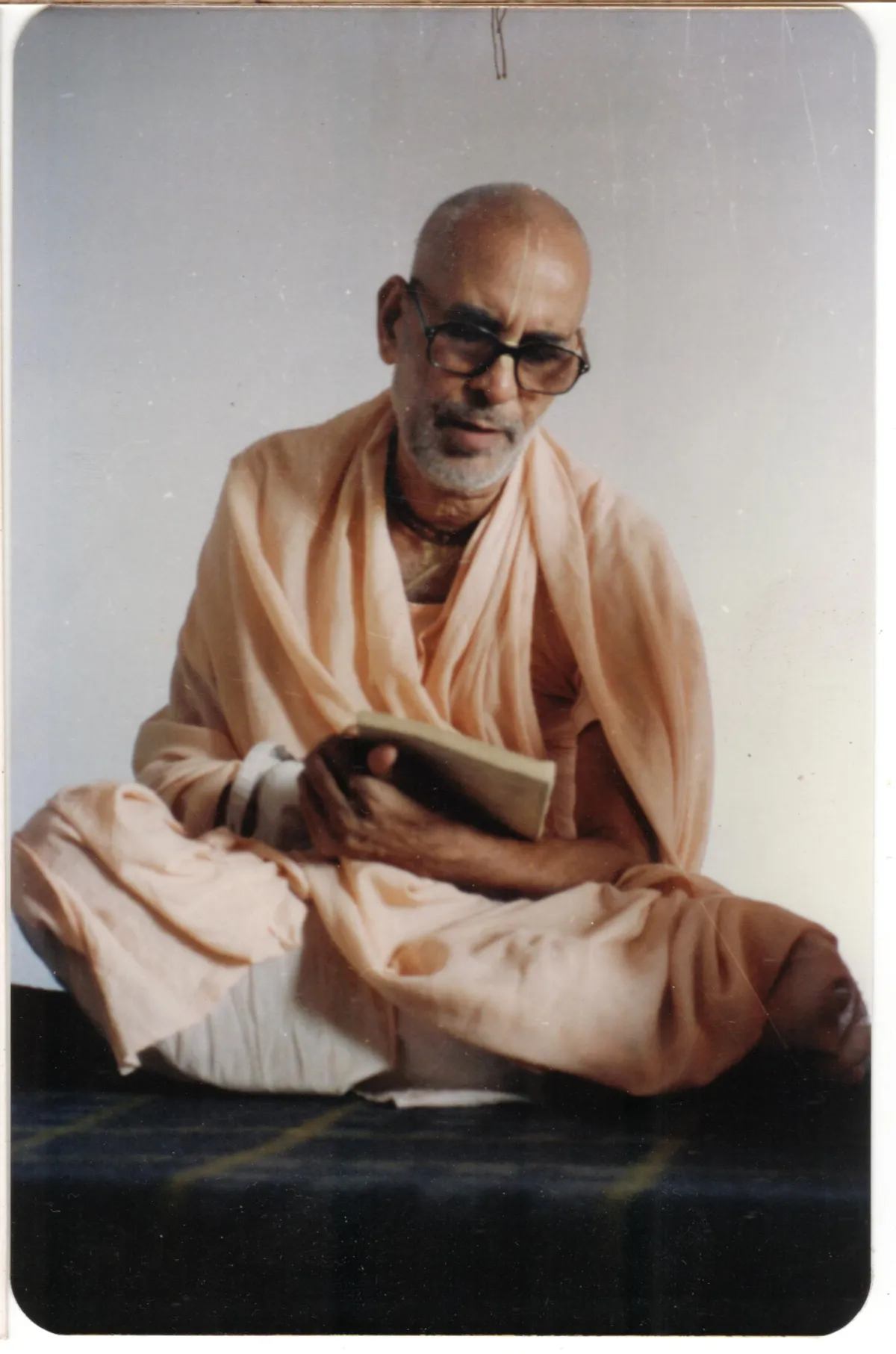
Ānukūlyena-kṛṣṇānuśīlanam is bhakti. It is remembrance of Kṛṣṇa in a favorable way. The services we perform to please Kṛṣṇa through the agency of our body, mind, and words should always be practiced. We should serve Kṛṣṇa in a favorable way and not in an unfavorable way. It has been said, “ānukūlyena-kṛṣṇānuśīlanam,” ‘anu’ means to perform devotional services under the guidance of a very bona fide guru, he is a realized soul. The guru not only knows śāstra, but he is realized in the esoteric truths of pure devotional service to Kṛṣṇa. Śāstra-jñāna, the knowledge of the śāstras cannot do anything. If the guru knows Vedas, Upaniṣads, the epics, the words of the Gītā, and all scriptures and is capable of giving ornate lectures filled with all the philosophies of prema and its corollaries; in other words, his credentials as a bona fide lecturer are very good. But, if he has no realization of the service of Kṛṣṇa, he shouldn’t be accepted as one’s guru. Because all his credentials fail him on account of this shortcoming. In the Śrīmad-Bhāgavatam and the Vedas, the definition of a guru has been given.
***tasmād gurum prapadyeta jijnasuh shreya uttamam…
He may be well versed in the Gītā, Vedas, and Upaniṣads, but this scholarship is external. There is one other important consideration—the guru should be completely aloof from sense gratification. He should not be involved in fulfilling his worldly desires. He should be detached from all sense gratification and worldly desires. Thirdly, and most importantly, he should have some realization of serving Kṛṣṇa. If he doesn’t have this realization, then he may be extremely renounced like Śaṅkara and Śaṅkarites, or the māyāvādīs who are so detached from this world; but they are not qualified to obtain even a particle of bhakti; hence, he too will be counted among the māyāvādīs on account of his lack of devotion to the Lord. Vast learning and being extremely renounced are not qualifications for obtaining bhakti. Therefore, those who are extremely attached to fulfilling their worldly desires and those who are extremely detached from this material world are not qualified to come in the bhakti line. There should be some attachment also because this attachment will be transferred into attachment for bhakti and if there is no attachment, then where is the scope for bhakti to arise? Attachment is a part of prema, so it must be there.
For instance, Bilvamaṅgala Ṭhākura was very attached to a prostitute. But, by transferring his attachment to the Lord, he became a very, very good devotee. So, attachment is not bad. But, the criteria is that one should be attached to the association of very good devotees who have some realization of their worshipful Lord, then the devotion of a kṛṣṇa-bhakta will very soon turn into bona fide love for Kṛṣṇa. I know that my language is poor, but yet, all of you listen. Therefore, I cannot fully express my moods and views in English. If I could speak in Hindi, which is my mother tongue, then I could fully express myself. But yet, I will speak however much I can in English. And perhaps, you will ignore any mispronunciations and only grasp my moods. So, in ‘ānukūla,’ anu means nirantara, continuous. There should be no wall or any other obstruction. The flow of bhakti is like the flow of honey from a bottle. Our bhakti should be like this flow of honey in an unbroken stream. No hindrance should break the flow of our bhakti. Bhakti should run on throughout the day and night, and indeed, bhakti should continuously flow like an unbroken current or stream throughout one’s life. But, these devotional practices should be performed under the guidance of any bona fide guru, or a śikṣā-guru. Gurudeva is an uttama-mahā-bhāgavata Vaiṣṇava. Any mahā-bhāgavata should be considered as one’s śikṣā-guru. We should not think that Diksha-guru is most superior while śikṣā-guru in most inferior. We should not be of this mentality. The position of a śikṣā-guru is not minimized anywhere. The scriptures also glorify the position of the śikṣā-guru along with the Diksha-guru.
The initiating spiritual master is considered the form of the Lord and the instructing spiritual master is considered the personality of the Lord. Both are the same. If Sanātana Gosvāmī is the dīkṣā-guru and Rūpa Gosvāmī is the śikṣā-guru, then is there any difference between them? There is no difference between them.
[CC-by-NDNC Bhakta Bandhav]
Radlett 17 May 1996