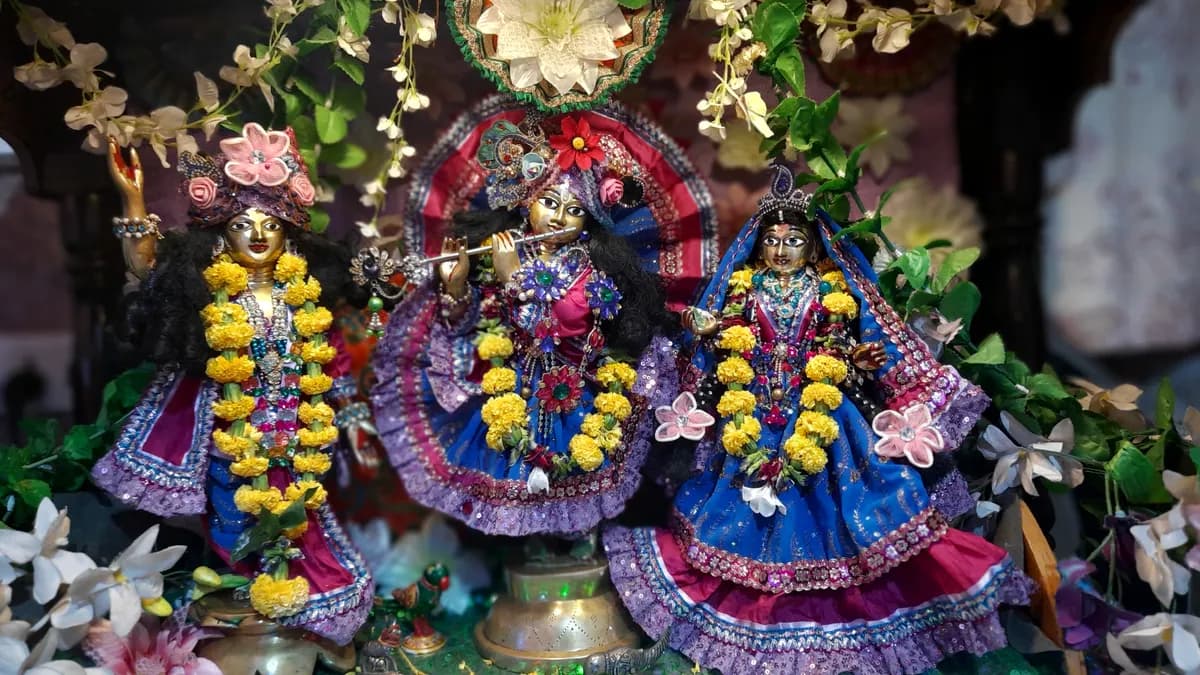
20 March 2017 Gita Govinda: Canto 7, Ch.14
As the full moon rose to its highest point, Srimati Radharani, afflicted by separation from Krsna, began to chant the bija-mantra. Mantra and the mantra-devata are non-different. If you think of the mantra-devata while you chant the mantra, that devata will surely appear to you. When He comes He can do one of two things, according to the chanter’s desire He will either take and keep the chanter of the mantra with Him, or He will become the property of the chanter.
Mostly, the followers of vaidhi-marga desire the first of these two. This was the case with the thousands of princesses in Narakasura’s prison. The girls chanted mantra and the devata of that mantra came, saved them, and accepted them as His own. After accepting them, He fulfilled all their desires. He gave them each a palace with many friends, children, servants, and so on.
In the other type of instance where the mantra-devata appears to the chanter of mantra, He thinks, “What is this? This person does not want anything from Me. This person wants only Me. But this is a problem. How can I give myself to this person? How can I be only theirs? I am bound to reciprocate with all of My bhaktas. How can this be possible?”
Despite the fact that the mantra-devata has the ability to give any desirable thing, this second kind of person desires nothing but Him—not anything from Him. They want Him, Krsna, to be theirs, so they can offer Him prema-seva.
Krsna says, “It will make Me happy if you accept something from Me.”
But these persons say, “No. This cheating of Yours is not good. I am not interested in the tricks of a dark cheater. You want to give me something so You can run away, thinking that I will be satisfied with that presentation. You can cheat everyone but you can’t cheat anyone here in Vraja-mandala. You are really dark inside and out. You can utilize this darkness to hide from everyone, but you can’t hide from us—the Vrajavasis. Before the Vrajavasis You are not that clever at all.”
The Vrajavasis do not accept trifles. They are serious. They are not interested in an incomplete relationship with Krsna. But Krsna finds Himself unable to fully surrender Himself to one person. He cannot stay in one place only. Thus there is a battle. Jayadeva Gosvami has used the word ‘samara’ to indicate this.
Before Yasoda, Krsna is the child Gopala, before the cowherd boys He is a sakha, before those in santa-rasa He is Nirvikara, but those in madhura-rasa want Krsna completely and without anything hidden from them.
Krsna is bound by the Vraja-devis’s love. “They have arrested Me,” He says. “My mother tried to tie Me up but she could not bind Me as they have.”
sva-mātuḥ svinna-gātrāyā
visrasta-kabara-srajaḥ
dṛṣṭvā pariśramaṁ kṛṣṇaḥ
kṛpayāsīt sva-bandhane
Śrīmad-Bhāgavatam 10.9.18–21
She (Yasoda) had become exhausted by joining so many ropes together and her body had become covered with perspiration. The flowers woven into her hair had fallen from her loosened braid, and had scattered here and there. Seeing His mother’s fatigue and feeling compassionate, small Kṛṣṇa then allowed His mother to bind Him.
Krsna was arrested and bound by Yasoda Mata, but those bonds did not last so long. They were opened by Nanda Baba.
When Krsna is bound together with Srimati Radharani He is known as Radha-Damodara. Only Srila Rupa Gosvami has the power to bind Krsna like this. He gave entrance into the special service of that Radha-Damodara to Jiva Gosvami.
Jayadeva Gosvami sings this song in the tala, or rhythm, known as yati. The word yati is significant. Krsna thought, “What a frightful battle! I cannot win this battle. And what will happen if I lose? My only option is to become a yati, or a sannyasi.”
How can Krsna be completely surrendered in one place alone? How can He give Himself completely to one bhakta, denying all the other bhaktas? Although anything is possible for Him, this is practically impossible. Therefore, He decides to become a sannyasi. Sannyasis are everyone’s friend because they are not bound by any one society or relation. When Krsna came as Mahaprabhu, where was Mahaprabhu and where was Gadadhara Pandita? They stayed in separate places. Where was Ramananda Raya and Svarupa Damodara and where was Mahaprabhu? They stayed separately, but despite this they had an eternal affection and connection. Sometimes separation can be the most effective means of connection.
During the fight, Krsna thinks, “They have such a infallible weapon—the bija-mantra.” Then He Himself takes up the chanting of the bija-mantra. That Krsna who chants the bija-mantra and is in the form of the spiritual master of the universe, jagad-guru, is Sacinandana Gaurahari—He who brought for everyone the unnatojjvala-rasam-sva-bhakti-sriyam.
By chanting this bija-mantra Krsna can become yours. There are two conceptions: tadiya and madiya. Some people say to Krsna, “I am Yours.” And some say, “You are mine.” There is a big difference between these two moods. Those who say I am Yours may give Krsna a headache to deal with. But there are special people who only say, “You are mine—my responsibility. I will take care of you and give you love.”
Some people put on a huge festival on Janmastami, but then the next day they do nothing. That day there is no bhoga offering, no decoration, no kirtan, nothing. But there are others whose service never stops. They conduct a nitya-utsava, a continuous festival for Krsna’s pleasure. Every day there is a new feast of prasada, kirtana, and hari-katha. Krsna likes this ever-fresh service.
Some people pray to Krsna, “O Lord. I am so horrible. I have so many bad qualities. I am so lusty and angry.” This is one kind of adhikara. But some people’s adhikara is different. They don’t speak like this to Krsna. What does Yasoda say to Him?
“Hey! Dirty little piglet! Why are You rolling about in the mud?”
And Krsna says, “Yes mother, I have the svarupa of a pig. What can I do? I like this vraja-raja—the dust of Vraja.”
Yasoda has the understanding that, “Krsna is mine,” and she a feels responsibility to care for Him and chastise Him if need be. She is always thinking about what is best for Him. The Vraja-devis’ love is even deeper than Yasoda Mata’s.
By chanting the bija-mantra (klim) spiritual power and energy will come to you and you will do continuous seva. You will not even think about rest.
Chanting the bija-mantra, with the proper mood, will help increase your service tendency. Aspire for the understanding that, “Krsna is mine.” A newly married girl will serve everyone in her husband’s household and thus win their hearts. If she simply comes there and thinks, “They will all serve and take care of me,” then no one will be happy with her. Through seva, relationship can be established and nurtured.
“Guru-pada-padma is making me ready for krsna-seva. I am ready to learn the way of this continuous seva.” This is the proper mood of a disciple.
Krsna decided to become a yati because a sannyasi’s business is to serve everyone.
smara-samarocita-viracita-veśā
dalita-kusuma-dara-vilulita-keśā
kāpi madhuripuṇā
vilasati yuvatir adhika-guṇā (refrain)
Krsna’s appearance is in accordance to the mood of His bhakta. He has many sevakas. One of them says, “He is my Syamusandara.” Another sevaka says, “He is white.” Another sees Him as black, and another as blue. What can we conclude? Krsna therefore comes in all kinds of forms and colors, to satisfy His bhaktas.
Many people say, “Aham brahmasmi. I am Brahma. You are Brahma. Brahma is here. Brahma is there.” There are many kinds of ideas about Brahma, but where is the real and complete Parabrahma? Therefore, there is a fight, because people with different levels of qualification perceive the Supreme Person according to their eligibility. We see this all over the world, with different religions fighting, arguing that their conception of God is absolute and others are false. But actually, the highest conception is within Vraja, where the Vrajavasis do not even recognize Krsna as God; He is only their friend, their dearmost beloved.
Devotees feed and decorate their personal Deity according to their moods and they receive individual reciprocation from Him. When an ordinary girl looks at a picture of a boy—or vice versa—and longs to have a loving meeting with that person, they can remain only engrossed in fantasy. But when someone chants the bija-mantra, Natavara Nanda-kisora will actually come to that person to accept love and service.
Sometimes, one sakhi sees that another sakhi looks very happy. Immediately, she thinks, “Aha! Krsna has touched you today. He poked you with His flute or perhaps embraced you. Did He kiss you?” This is not all. At times sakhis speak like this to the creepers. When they see that a creeper is full of many flowers which are dropping from the creeper’s limbs in great numbers, they say, “Definitely you have been touched by Krsna!” How can we understand this? This is a mysterious battle.
There are many devotees, but Krsna only becomes the property of those who have no qualities, who are nirguna, or in other words, those who, whether possessing any kind of qualification or ability or not, offer their entire existence—what to speak of possessions and qualities—to Krsna.
Qualities acquire a person and bind him. If you think you are qualified, you separate yourself from Gopinatha Krsna. Krsna will not be attracted to you. He does not go to those who think they are special. He goes to those who have nothing—only the bija-mantra. Without this, you can offer Him many things, but He will not be happy. He is happy with those who are situated in nirguna-tattva.
Krsna wanted Yasoda Mata’s breast milk, but she desired to save the milk on the stove. She wanted to make Krsna many varieties of tasty sweets, but Krsna just wanted Her breast milk. There was a fight. Yasoda pulled Krsna off of her lap and put Him down as she sped off to save the milk. Krsna began to cry loudly. He thought, “I don’t need anything. I only want you and your love. I want nothing else!”
Just see this battle between the bhaktas and Krsna.
hari-parirambhaṇa-valita-vikārā
kuca-kalaśopari taralita-hārā
The Vraja-devis wear beautiful dresses and ornaments, but then they think, “These decorations of ours are keeping Krsna separate from us.” Then they discard everything and offer themselves completely to Krsna. Krsna thus makes them renunciants as well.
vicalad-alaka-lalitānana-candrā
tad-adhara-pāna-rabhasa-kṛta-tandrā
Without even speaking, Krsna can steal a person’s heart with just His eyes. His eyebrows are black, His hair atop His head is black, He Himself is black—but even more black are the pupils of His eyes, which are like deep wells from which Anuraga is overflowing and going everywhere.
The sakhis behold this madana-svarupa and become stunned.
cañcala-kuṇḍala-lalita-kapolā
mukharita-rasana-jaghana-gati-lolā
Shining earrings swing to and fro and kiss the face of that madana-svarupa, making Him even more beautiful. Anuraga flows in the form of perspiration from His sweet and restless face.
dayita-vilokita-lajjita-hasitā
bahu-vidha-kūjita-rati-rasa-rasitā
The sakhis, although shy, embrace that svarupa within their heart.
vipula-pulaka-pṛthu-vepathu-bhaṅgā
śvasita-nimīlita-vikasad-anaṅgā
The bodiless spirit of Ananga possesses them and the waves of a restless ocean of ecstasy crashes about inside them. Completely in a state of madana-avesa, absorbed in amorous desire, they barely manage to breath properly and find it impossible to open their eyes. Shivering, they try to speak, but cannot do so. Krsna has possessed them, as a ghost possesses the body of a person.
śrama-jala-kaṇa-bhara-subhaga-śarīrā
paripatitorasi rati-raṇa-dhīrā
During the battle to bring Krsna into their own heart, the Vraja-devis sweat and tightly hold on to Krsna in a tight embrace. They want this state to remain life after life so they can continuously serve Him.
śrī-jayadeva-bhaṇita-hari-ramitam
kali-kaluṣaṁ janayatu pariśamitam
How Hari comes, plays, fights, and removes all obstacles in the way of pure loving service—this is all explained here by Jayadeva Gosvami.
In Kali-yuga kama-vikara, the movements of lust, claims everyone. But if you chant the bija-mantra then the filth of kali—kali-mala—will be
obliterated. You will never have a contaminated mood. If Krsna comes into your heart then there can be no problems for you.
viraha-pāṇḍu-murāri-mukhāmbuja-
dyutir ayaṁ tirayann api vedanām
vidhur atīva tanoti mano-bhuvaḥ
suhṛd aye hṛdaye madana-vyathām
Now Murari has entered the heart. He has left no place for ordinary Kama-deva. In all directions suffering can be found, but if Krsna is brought into the heart then there can be no pain.
[CC-by-NDNC Bhakta Bandhav]