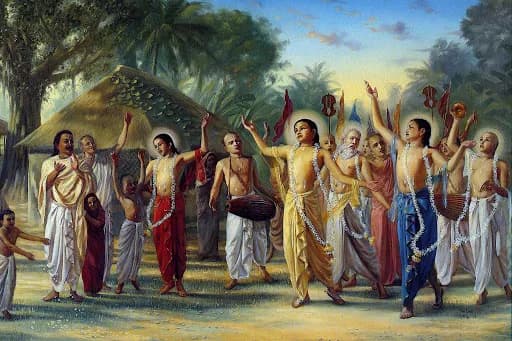
Verse One
Ceto-darpaṇa-mārjanam and the Parakīyā-parāmpara
ceto-darpaṇa-mārjanaḿ bhava-mahā-dāvāgni-nirvāpaṇaḿ
śreyaḥ-kairava-candrikā-vitaraṇaḿ vidyā-vadhū-jīvanam
ānandāmbudhi-vardhanaḿ prati-padaḿ pūrṇāmṛtāsvādanaḿ
sarvātma-snapanaḿ paraḿ vijayate śrī-kṛṣṇa-sańkīrtanam
Śikṣāstakam 1
Glory to the śrī-kṛṣṇa-saṅkīrtana, which cleanses the heart of all the dust accumulated for years and extinguishes the fire of conditional life, of repeated birth and death. This saṅkīrtana movement is the prime benediction for humanity at large because it spreads the rays of the benediction moon. It is the life of all transcendental knowledge. It increases the ocean of transcendental bliss, and it enables us to fully taste the nectar for which we are always anxious.
The four Vaiṣṇava-sampradāyas, each headed by their powerful ācāryas, established their different doctrines before the time of Mahāprabhu. The devotees of these sampradāyas were taught the process by which one can be purified and able to make a relationship with Bhagavān. These sampradāyas have their specialties. For example, the Śrī-sampradāya and the Rudra-sampradāya are known for following strong etiquette and principles, and the Brahmā-Madhva-sampradāya is known for explaining elaborate siddhānta. However, when Mahāprabhu came to this world, He presented something that had never been revealed before. Mahāprabhu's most extraordinary and sublime gift to this world, as well as the complete specialities and conceptions of all Vaiṣṇava-sampradāyas, is contained in the eight verses He composed, known as Śikṣāṣṭakam.
The four Vaiṣṇāva-sampradāyas have svakīyā-paramparās, or disciplic lineages based on formal acceptance of initiation, but Mahāprabhu’s line, which is within the Brahmā-Madhva line, is the parakīyā-parāmpara or bhāgavat-paramparā, where, although dīkṣa is present, a transcendental heart to heart connection, based on sikṣa, is of paramount importance. In the other lines, the worshipful Lord is svakīyā, but in the Gauḍīya line, the supremely worshipful object of our devotion is the Divine Couple, in the parakīyā-bhāva. This is the highest of all conceptions. Along with this conception of parakīyā-bhāva, Mahāprabhu’s teachings are decorated by the specialty of acintya-bhedābheda-tattva.
In his discussions with Mahāprabhu about the ultimate goal of life and the means to attain it, Rāya Rāmānanda said:
varṇāśramācāravatā
puruṣeṇa paraḥ pumān
viṣṇur ārādhyate panthā
nānyat tat-toṣa-kāraṇam
Caitanya-cāritāmṛta, Madhya-līlā 8.58
Śrī Viṣṇu, the Supreme Lord, is worshiped by those people who properly follow the system of prescribed duties in accordance to one’s varṇa and āśrama, spiritual and social classification. This is the way to satisfy Him.
Mahāprabhu was not pleased with this. He said, “Eho bāhya, āge kaha āra—this is external, speak further.”
Mahāprabhu was not satisfied with the process of the svakīyā-parampara, and inquired from Rāmānanda Rāya about the true nature and svarūpa of Rādhā, Kṛṣṇa, rasa, and prema:
kṛṣṇera svarūpa kaha rādhāra svarūpa
rasa kon tattva, prema kon tattva-rūpa
Caitanya-cāritāmṛta, Madhya-līlā 8.11
Please tell Me, what is the nature of Śrī Rādhā and of Śrī Kṛṣṇa? What is the tattva regarding rasa and what is the intrinsic nature of prema-tattva?
After discussing these four tattvas, Mahāprabhu manifested the Śikṣāṣṭakam. The Śikṣāṣṭakam represents aṣṭa-kālīya-līlā, the eightfold daily pastimes that go on in the transcendental realm of Goloka-dhāma. Taking shelter of Śrī Śikṣāṣṭakam is the means to gain entrance into the realm of bhajana and aṣṭa-kālīya-līlā-smaraṇa.
All eight segments of nitya-līlā are present within the eight verses of Śikṣāṣṭakam. How can these pastimes be realized? It is important that this be explained. Many people approach bābājīs and receive so-called siddha-praṇālī from them. These unfortunate souls will be unable to properly understand Mahāprabhu’s line. Those who fail to recognize and associate with a pure devotee of the Gauḍīya line deprive themselves of the greatest treasure. Blind and misguided, they think that they can purchase entrance into Rādhā and Kṛṣṇa’s eternal pastimes for a few rupees.
In the first verse of the Śikṣāṣṭakam, Mahāprabhu starts by saying: ceto-darpaṇa-mārjanam, which means, cleansing the mirror of the heart. What is the inner meaning of this? If Mahāprabhu said in the discussion with Rāmānanda Rāya that varṇāśrama-dharma is external, then would He be referring only to the material body in this verse? No. He tells this for the queens of Dvārakā and to those with sadharani-rati and samañjasa-rati, meaning, that even these moods must be given up if we wish to serve directly in Rādhā-Kṛṣṇa’s pastimes. We must cleanse even this mood from our heart, if we wish to enter transcendental Vraja. Śrīla Raghunātha dāsa Gosvāmī states this clearly in his Manaḥ-śikṣā, with the words: api tyaktvā lakṣmī pati ratiṁ vyoma nayanim. The bhaktas in svakīyā-bhāva are not one-pointed to Kṛṣṇa. They do not follow the footsteps of the Vraja-devīs. During niśānta-līlā, they do not intimately serve Rādhā-Kṛṣṇa.
Only when a person has the guidance of the Vraja-devīs will govinda-līlā appear in his heart. When that līlā appears, that person will be one-pointed in kṛṣṇa-bhakti and then the mirror of his heart will be truly cleansed—ceto-darpaṇa-mārjanam. Mahāprabhu did not say this just to mean we must become free from lust, anger, greed, illusion, and so on. These things are only related to the body and not the soul. The soul is a part-and-parcel of Kṛṣṇa. Only when the soul is covered by the body, mind, intelligence, and false ego, is it attributed by qualities like lust, greed, anger, envy, and jealousy. But Mahāprabhu did not come to just teach people how to get free from these material coverings. This had already been established. Mahāprabhu came to establish vraja-prema and the parakīyā-parāmpara.
The deeper meaning of ceto-darpaṇa-mārjanam is that one must not go to the side of Candrāvalī nor become a follower of Dvārakā’s queens, or like Kubjā or any Mathurāvasi. These first words of the Śikṣāṣṭakam, being connected to the Divine Couple’s pastimes at the end of night, urge us to only follow the Vraja-devīs and to assist them in their service to Rādhā-Kṛṣṇa when They are leaving the kuñja during niśānta-līlā. By meditating on the heart-breaking feelings of the gopīs at this time, when the Divine Couple must separate, one’s heart will become completely cleansed. Then a desire to properly serve Rādhā-Kṛṣṇa will awake in the sādhaka’s purified heart. One will feel the burning of the fire that ignites when Kṛṣṇa must leave and return to Nanda-bhavana and Rādhika to Her home.
The mahā-dāvāgni, or raging forest fire, mentioned next in this verse, can be understood to mean the burning fire of separation that is felt when deprived of the association of the nitya-siddhas, the eternal perfected souls of the spiritual abode. In this way, we can understand the meaning of Śikṣāṣṭakam in different levels of depth.
Śrīla Jīva Gosvāmī describes in his Gopāla Campu and Śrīla Kavi Karṇapura Gosvāmī describes in his Ānanda Vṛndāvana Campu how the gopīs suffered in separation from Kṛṣṇa before they even met Him. Their pain started simply after hearing Him play the flute. Some only saw a picture of Him and others actually caught a glimpse of Him from a distance. But from that time their hearts started to burn and they felt an intense desire to meet Kṛṣṇa, although they did not know how to do so. They felt themselves to be very low and fallen. They did not know how Kṛṣṇa would become their dearmost beloved, but they knew that it must happen if they were to continue living.
Paurṇamāsī found the lamenting young gopīs on the bank of Yamunā and she kindly gave them a mantra and said, “Chant this mantra that I gave you and your desire will be fulfilled.”
Later on, when at last they had darśana of Kṛṣṇa, He promised them that He would call them to meet with Him after one year. During this year, they got training from the nitya-siddhas. They became strong and then the fire of separation, the bhāva-mahā-dāvāgni, was finally pacified.
Śreyaḥ-kairava-candrikā-vitaraṇam. Then, the śreyaḥ-candrikā, the soothing rays of prema touched the gopīs’ hearts. They were now completely protected by their strong anurāga. Vidyā-vadhū-jīvanam. They then realized that their life and soul was service to Kṛṣṇa in the mood of a paramour, under the guidance of svarūpa-śakti Śrīmati Rādhārānī. Ānandāmbudhi-vardhanam. They then became fully immersed in the ocean of rasa.
The Śrīmad-Bhāgavatam (8.3.20) states:
ekāntino yasya na kañcanārthaṁ
vāñchanti ye vai bhāgavata-prapannāḥ
aty-adbhutaṁ tac-caritaṁ sumaṅgalaṁ
gāyanta ānanda-samudra-magnāḥ
Those who are surrendered exclusively unto Bhagavān, and who desire nothing else but to attain Him, are immersed in an ocean of bliss by singing about His wonderful and supremely auspicious activities and qualities.
From morning to evening, the gopīs did not talk to anyone. They simply did kṛṣṇa-kīrtana and were lost in bliss.
evaṁ-vrataḥ sva-priya-nāma-kīrtyā
jātānurāgo druta-citta uccaiḥ
asaty atho roditi rauti gāyaty
unmāda-van nṛtyati loka-bāhyaḥ
Śrīmad-Bhāgavatam 11.2.40
In the heart of one who adopts such a transcendental path, attachment for chanting the name of his most dear Lord arises and melts his heart. Now he rises above the condition of the general mass of people, and he is beyond caring for their opinions and views. In a natural way—not out of pretense—he acts as if mad. Sometimes he bursts out laughing and sometimes he sheds floods of tears. Sometimes, in a loud voice, he calls out to Bhagavān and sometimes, with a sweet voice, he sings Bhagavān’s glories. At other times, when he perceives his beloved standing before his eyes, he even starts dancing in order to please Him.
This ānanda which was felt by these sādhana-siddha-gopīs, and which is felt by any sādhaka who reaches this stage, does not diminish. It is ever-fresh at every step—prati-padam.
Sarvātma-snapanaṁ. Only by surrendering oneself fully at the lotus-like feet of svarūpa-śakti Śrīmatī Rādhārānī can one ever hope to experience these stages mentioned in this verse.
Paraṁ vijayate śrī-kṛṣṇa-saṅkīrtanam. The highest kīrtana is the kīrtana taught by the Vraja-devīs. The Gopī-gīta, Brahmāra-gīta, Praṇaya-gīta, Veṇu-gīta, and Yugala-gīta are the five life-airs, the pañca-prāna, of the Bhāgavatam. Only the Vraja-devīs perform samyak-kīrtana or complete kīrtana. No other kīrtana can be thus named.