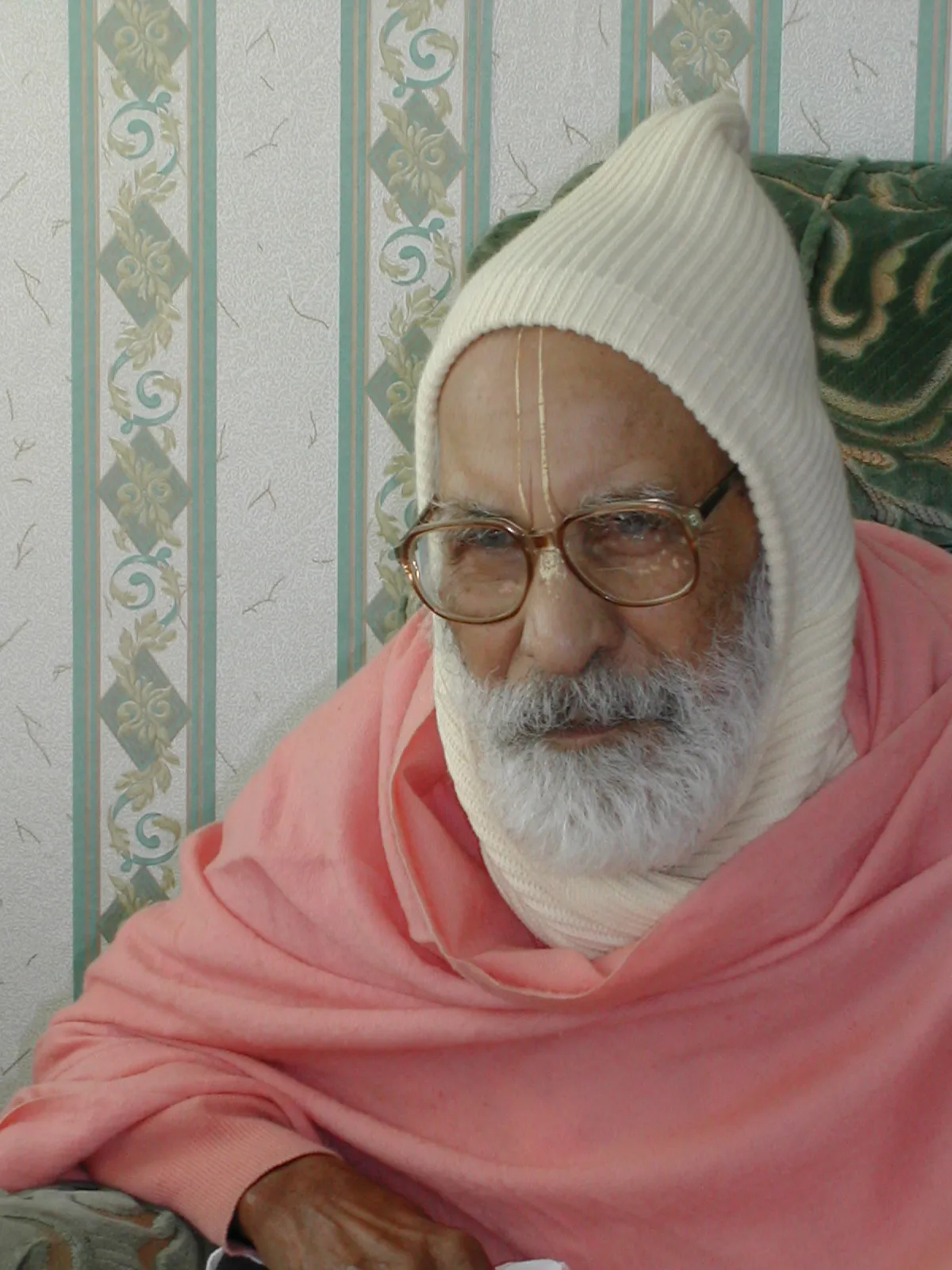
When Śukadeva Gosvāmī heard this verse from the hunters, he returned to his father and said, “You are my guru.” Śukadeva was playing the role of a conditioned soul, when in actuality, he was an eternally liberated associate of the Lord. Śukadeva then returned to Vyāsadeva, who then recited the entire Bhāgavatam to him. Śrīla Vyāsadeva has written this Bhāgavatam.
yasyāṁ vai śrūyamāṇāyāṁ kṛṣṇe parama-pūruṣe bhaktir utpadyate puṁsaḥ śoka-moha-bhayāpahā Śrīmad-Bhāgavatam 1.7.7 [By the culture of hearing and following this Śrīmad-Bhāgavatam, bhakti to Vrajendra-nandana Śrī Kṛṣṇa immediately manifests in the heart, dispelling lamentation, delusion and fear. Only then is Śrī Kṛṣṇa captured in the heart of such a bhakta.]By the grace of Nārada Ṛṣi, Vyāsadeva realized all truths and saw what he had realized as direct (pratyakṣa). He then wrote Śrīmad-Bhāgavatam, but for whom? For those who are against Kṛṣṇa, and come to this prison-like world which is controlled by māyā. For such conditioned souls, Vyāsadeva manifested Śrīmad-Bhāgavatam. Bhāgavatam is not a mere book; it is the embodiment of Śrī Rādhā and Kṛṣṇa Themselves. Vyāsadeva preached Śrīmad-Bhāgavatam for the benefit of all conditioned souls. After that, the occasion arose where Śrī Śukadeva Gosvāmī entered the sabhā, assembly of Śrī Parīkṣit Mahārāja. Śrī Parīkṣit Mahārāja was cursed to die in seven days. He was cursed to be bitten by a snake. Śukadeva Gosvāmī entered the assembly of Parīkṣit Mahārāja, who had completely restrained himself from taking any food or water. Parīkṣit Mahārāja was seated on the bank of the Ganges, accompanied by lakhs and lakhs of ṛṣis and maharṣis, who had also assembled there. Sages like Vyāsadeva, Nārada, Parāśara, and all the great ṛṣis had assembled there. Parīkṣit Mahārāja and others stood and offered the “vyāsa-āsana,” to Śrī Śukadeva Gosvāmī. Folding his hands, Parīkṣit Mahārāja asked Śukadeva Gosvāmī, “I want to know the duty of a person who is set to die within a moment? What should such a person do? And what is the duty of those people, who are set to die within three days, four days, 10 years, 100 years; as all must die? What should they do?” Śrī Parīkṣit Mahārāja asked Śrī Śukadeva Gosvāmī these questions. The first question concerned those who are to die in a moment, and the second concerned those who may die today, tomorrow, the day after tomorrow, within some days, months, or years; but who are destined to die. We should understand that we will have to die someday. Anyone who comes to this world must die. Those who have taken birth must surely die. When we depart from our bodies, we will not be able to take anything along with us; not a farthing or anything. This body and its concomitant paraphernalia will be left behind. So we should try to serve Kṛṣṇa and listen to hari-kathā. If we perfect our devotional practices in this human body; we will never have to enter the womb of another mother. We will forsake birth and death. If we don’t perfect ourselves in one birth; we may do so very soon.
dharmaḥ projjhita-kaitavo ’tra paramo nirmatsarāṇāṁ satāṁ vedyaṁ vāstavam atra vastu śivadaṁ tāpa-trayonmūlanam Śrīmad-bhāgavate mahā-muni-kṛte kiṁ vā parair īśvaraḥ sadyo hṛdy avarudhyate ’tra kṛtibhiḥ śuśrūṣubhis tat-kṣaṇāt Śrīmad-Bhāgavatam 1.1.2 [Completely rejecting all religious activities which are materially motivated, this bhāgavata Purāṇa propounds the highest truth, which is understandable by those devotees who are fully pure in heart. The highest truth is reality distinguished from illusion for the welfare of all. Such truth uproots the threefold miseries. This beautiful Bhāgavatam, compiled by the great sage Vyāsadeva (in his maturity), is sufficient in itself for God realization. What is the need of any other scripture? As soon as one attentively and submissively hears the message of Bhāgavatam, by this culture of knowledge the Supreme Lord is established within his heart.]Those who hear Bhāgavatam from any bona fide Vaiṣṇava, will have Kṛṣṇa enter their hearts very soon, through the medium of the Vaiṣṇava’s hari-kathā. hari-kathā is not merely hari-kathā by itself, it is Kṛṣṇa Himself. Kṛṣṇa will broom our hearts of all its dust particles. What are those dust particles? They are āsakti (attachment) to this world. This attachment is characterized by conceptions such as, “I am this body. These are my children. This is my husband. She is my wife. All wealth, gardens, everything is mine! While this belongs to others, this is mine. This earth is mine, and what’s left is for others.” Everything belongs to Kṛṣṇa; we are not the owners. Kṛṣṇa is the Supreme landlord of this world, no resident of this world can claim otherwise. Kṛṣṇa is one without a second. Kṛṣṇa is the Supreme Personality of Godhead.
[CC-by-NDNC Bhakta Bandhav]