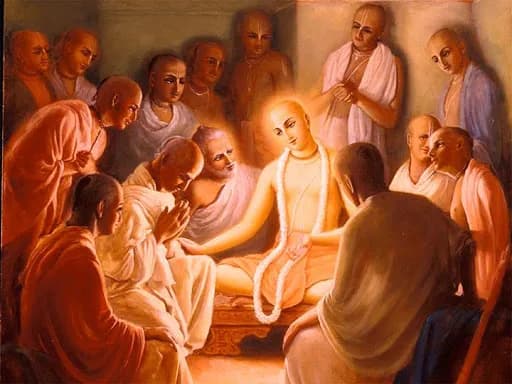
In his Sri Sanmodana-bhasya commentary on the third verse, Srila Bhaktivinoda Thakura describes four symptoms found in the the sadhaka who chants the holy name of Sri Krsna free from all offenses: (1) natural humility born of complete detachment from material sense gratification, (2) pure compassion devoid of envy, (3) purity of heart free from materialistic false ego and (4) an attitude of respect towards everyone in accordance with their respective positions.
1. Trnad api sunicena: Humbler than a Blade of Grass
When the holy name, which is the personification of transcendental rasa, makes its appearance in the heart of the sadhaka, it overwhelms his heart and he begins to think thus:
“Aho, I am by nature infinitesimal consciousness and a servant of Sri Krsna. I have absolutely no use for mundane material objects. Alas! Alas! Due to my apathy towards Sri Krsna, I now find myself in a miserable plight. I have fallen into the cycle of repeated birth and death, and I am being scorched by various kinds of afflictions. By the mercy of the spiritual master and the Vaisnavas, I have now understood that my indifference can be dissipated only by executing the sadhana of devotion unto the Supreme Lord."
“By becoming situated again in my constitutional identity, I can obtain love for the Lord. Therefore until, by the grace of Bhagavan, I obtain release from material existence, I shall have to take support of the principle of appropriate renunciation (yukta-vairagya). While cultivating that knowledge which is relevant to the development of my relationship with Bhagavan (sambandha-jnana), I will accept only those things which are appropriate for the maintenance of life."
“Misery arising from scarcity, disease, lamentation and old age, as well as happiness arising from wealth, good health, strength, knowledge and so on are all manifest reactions of previous activities, known as prarabdha-karma. These I will certainly have to enjoy or suffer. Loss and gain, life and death, happiness and distress are not paramarthika, meaning that they have nothing to do with ultimate spiritual reality."
"Therefore I have absolutely no use for these mundane subjects. Thinking in this way, I shall say with great humility, Alas, Alas! Krsna! Gauracandra! O Lord of my very life! When shall I obtain unadulterated service unto You? Please be merciful upon this wretched and fallen soul, and accept me without delay. Speaking in this way, I shall pass my days, somehow or other, living either at home or in the forest."
“Even though grass is a material object, its ego in respect to matter is natural and reasonable. But my ego in respect to the present subtle and gross material bodies is fundamentally wrong, because it is not related to my pure constitutional nature. The ego of grass is real, but my material ego is unreal. Therefore it is only proper for me to become even lower than a blade of grass.”
2. Taror api sahisnuna: More Tolerant than a Tree
The meaning of the statement taror api sahisnuna is that the tree is so tolerant it does not neglect to offer its shade and sweet fruits even to the person who comes to cut it down. Because the devotee of Krsna is even more merciful than the tree, he does good to all – both friend and enemy. This compassion, free from envy, is the second symptom of saintly persons engaged in the performance of harinama-kirtana.
Persons who chant the holy name free from all offenses think as follows: “O Lord, my associates, who are all among the group of conditioned souls, are very unfortunate. How may they obtain attachment for Your all-auspicious holy name? Being blinded by the illusory energy, they are submerged in the happiness and distress of wife and children, wealth and property, victory and defeat, loss and gain, and birth and death.
They are filled with anarthas, and have not even the slightest detachment from mundane matter. They are bound by the stringent ropes of innumerable desires for sense enjoyment. At all times, they are busily engaged in seeking the fruit of karma and jnana. The fruit of karma is the momentary happiness of material enjoyment available in this world or in the heavenly planets.
This momentary happiness ultimately leads to suffering. The fruit of jnana is impersonal liberation. How may the desire be awakened in them to perceive their actual form?” Speaking thus, the practising devotee, being deeply moved with emotion, begins to sing in a very loud voice (Brhan-naradiya Purana 38.126):
harer nama harer nama
harer namaiva kevalam
kalau nasty eva nasty eva
nasty eva gatir anyatha
In Kali-yuga, there is no other way, there is no other way, there is no other way, than chanting the holy name, chanting the holy name, chanting the holy name of Lord Hari.
3. Amani: Absence of False Prestige
The word amani indicates the third symptom of the sadhaka engaged in the performance of kirtana, namely that he is free from false ego. All egotism arising from mystic powers, material opulence, wealth, beauty, high birth, social status, strength, prestige and high position associated with the gross and subtle bodies of the living entity who is bound by the illusory energy, is false and opposed to his real identity. To be free from such false designations is to be devoid of false ego.
One who, in spite of possessing all these qualifications, is further ornamented with the qualities of tolerance and freedom from false ego is most competent to chant the holy name. Such a pure practising devotee, completely renouncing the pride of being a brahmana householder, or the egotism of being in the renounced order of life, fixes his mind exclusively on the lotus feet of Sri Krsna and engages constantly in the kirtana of Krsna’s name.
4. Manada: Offering all Respect to Others
Lastly, the word manada indicates the fourth symptom of a sadhaka engaged in the chanting of the holy name, namely that he offers respect to everyone as befits their respective position. Understanding all living entities to be servants of Krsna, they bear no attitude of malice or vengeance towards anyone.
They please everyone with their sweet words and auspicious behavior, which are intended for the good of the entire world. They humbly offer respect as befits any individual’s position, whether he be a qualified brahmana or other dignified person of this world, or whether he be an exalted demigod such as Brahma or Rudra.
They pray to them for the awakening of devotion unto the Supreme Lord. In particular, they thoroughly and lovingly engage themselves in the service of the pure devotees of the Lord.
Thus sri-krsna-sankirtana, performed with the four above-mentioned symptoms, is the only method of attaining the topmost perfection of human life. This is the instruction of Sri Caitanya Mahaprabhu, the incarnation who delivers the conditioned souls in Kali-yuga.
# True Signs of Humility
Srila Prabhupada Sarasvati Thakura speaks about the quality of a Vaisnava in his Vivrti commentary on this verse:
Those who have no inclination at heart to serve Krsna and who are intoxicated with material enjoyment can never acknowledge their insignificance. Such recognition is foreign to the functional make-up of the hedonists. Tolerance is also absent from their character. The hedonists can never give up their false ego and material prestige. No material sense enjoyer is inclined to offer respect to another material sense enjoyer. Their nature is to be envious of one another.
On the other hand, the Vaisnavas, who are forever dedicated to the worship of the holy name, are even humbler than a blade of grass; they are more tolerant than a tree; and while remaining indifferent towards their own prestige, they are always eager to offer respect to others. In this material world, they alone are competent and able to chant the holy name of the Lord constantly.
The respect that pure Vaisnavas offer to their respective spiritual masters and other Vaisnavas is inspired by their innate propensity to honor others. This is known as svabhavika-manada-dharma. In order to enthuse their followers or dependents in bhajana, pure devotees display affection and encouragement towards them. This is done out of their natural pridelessness. This is known as amani-svabhava.
In other words the respect, honor and affection that such devotees offer is due to the innate feeling of the heart. Pure devotees do not consider such affectionate words of appreciation to be cheap material flattery. Furthermore, by tolerating the taunting remarks of the foolish, they exhibit their quality of forbearance.
Pure devotees constantly engaged in chanting the holy name consider themselves to be even lower than the straw in the street that is trampled beneath the feet of all living entities in this world. They never think of themselves as gurus or Vaisnavas. They consider themselves to be disciples of the entire world and the most fallen and insignificant of all. Knowing every atom and every infinitesimal living entity to be the residence of Sri Krsna, they do not consider anything to be inferior to themselves.
Devotees absorbed in chanting the holy name never desire nor request anything for themselves from anyone else in this world. Even if others bear malice towards them or commit violence against them, they never retaliate nor adopt a vengeful attitude; on the contrary, they pray to the Lord for the welfare of their tormentors.
The devotees who chant the holy name adorned with the above-mentioned qualities never abandon the devotional process received from their spiritual master in order to propagate new and divergent views. They do not fabricate concocted verses and chant those in place of the Hare Krsna mahamantra.
To preach the glories of the holy name, to write books based on unalloyed devotion and to perform kirtana, all under the guidance of the spiritual master, is not opposed to the principle of Vaisnava humility. In such activities there is no transgression of humility, for the devotee always considers himself to be low and fallen. Conversely, a false display of humility through speech or behavior to deceive others for some ulterior motive, in one who is lacking genuine simplicity, is not the true sign, symptom of humility.
The topmost devotees of the Lord (uttama-maha-bhagavatas), while engaged in chanting the holy name of Sri Krsna, never consider the moving and stationary entities within this material world to be items for their own enjoyment; rather, they see this entire material world as favorable for the service of Krsna and the devotees of Krsna. In other words they see everything in this world as related to Krsna; they see all moving entities as servants of Krsna and all non-moving entities as enjoyable by Krsna.
They never think this material world to be for their own enjoyment, but for Krsna’s enjoyment. They never invent new mantras, giving up the chanting of the mahamantra that they obtained from their spiritual master. They do not engage in propagating new theories and opinions.
To regard oneself as a guru of Vaisnavas is an impediment to one’s humility. Those who do not listen to the instructions of Siksastaka set forth by Sri Gaurasundara, who are forgetful of their actual spiritual identity, who are greedy for prestige and material gain and who are thus anxious to obtain the status of Vaisnava or guru to satisfy their senses, can never chant the holy name of the Lord.
A disciple who has faith in the kirtana performances of such persons also cannot obtain qualification for hearing the holy name. Therefore one should chant the holy name of the Lord while considering oneself lower than the straw in the street, being more tolerant than a tree, devoid of false prestige and offering all respect to others.