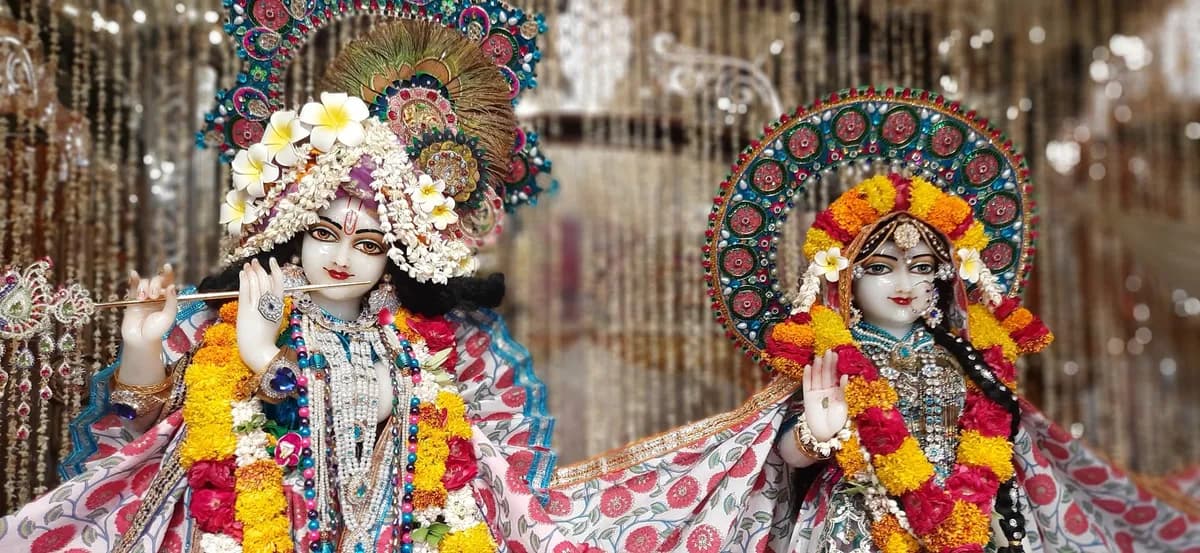
As soon as the jīvas come to this world, they engage in karma. Without performing karma, you cannot stay for a minute in this world. Some say, “I will not do karma.” But without karma, you cannot live for even a moment. However, by engaging in karma, you are bound to this world. How can the soul liberate himself from this world? Only by bhakti-yoga. By karma you are bound to this world, and the only way to stop the cycle of karma is by bhakti.
By worshiping Kṛṣṇa in His Deity form, as well as worshiping Tulasī, Gaṅgā, Yamunā, and the Lord’s devotees, your material attachments will be severed and your love and attachment will increase for Hari, Guru and Vaiṣṇavas. Then you will no longer engage in acts of karma because you will always be engaged in serving the Lord and His devotees.
Karma has many problems. You will always desire the fruits of your karma. Even those who profess to practice niṣkāma-karma-yoga, desire name and fame. The mentality of being the doer still lingers in the heart. Attachment to enjoying the fruits of your karma is very subtle.
Pious karmīs engage in many works meant for the upliftment of society. Many people open hospitals, orphanages, and charity-centers. Yet, rather than being liberated from this world, they are bound because people only remember them for their actions in this material world.
The people of this world remember many personalities who were nationalists, freedom fighters, and writers. By such remembrance, people will always remain arrested in this material world. They will not be liberated. But when people remember devotees like Rūpa Gosvāmī and Raghunātha dāsa Gosvāmī, they will get bhakti and be liberated from this ocean of material existence.
When people sever the bonds of karma and go near Kṛṣṇa, then what to speak of themselves, even their followers will be greatly benefited by remembering such a person. But people prefer to be sat-karmīs. Karma is a very strong shackle. It will not be possible for you to break this shackle by yourself. Kṛṣṇa has said in the Śrī Bhagavad-gītā (2.47):
karmaṇy evādhikāras te
mā phaleṣu kadācana
mā karma-phala-hetur bhūr
mā te saṅgo ’stv akarmaṇi
You have a right to perform your prescribed duty, but you are not entitled to the fruits of action. Never consider yourself to be the cause of the results of your activities, and never be attached to not doing your duty.
Karma should be done to fulfill Kṛṣṇa’s purpose, then the performer will not be entangled by the fruits of his actions. You should render service for Kṛṣṇa’s pleasure and happiness just as parents serve their children with love and affection.
A person thinks, “I have done bhajana since so many years now. But nothing is happening! No one respects me, no one offers me any property or temple. I am not famous, no one glorifies me. Everyone kicks me away. What do I have? My bhajana is useless. Others have many temples and followers. They have so many cars! They are so famous; they are glorified by everyone. But I have nothing.”
Although all facilities are given to the conditioned souls to advance in bhakti, their enjoying tendency only increases. They remain oblivious of their position as God’s eternal relative and friend. They forget their real responsibilities.
Kṛṣṇa sends sādhus here to help everyone remember Kṛṣṇa and cultivate devotion. Then they can quickly cross māyā and enter God’s abode. A silkworm eats leaves and makes a large cocoon around itself. After some time, the worm becomes entangled in its cocoon. There is no way for it to escape. Soon after, the silkworms are boiled and then people make many silken clothes.
Similarly, the karmīs form a complex network of karma and remain entangled. They continue to taste the fruits of their karma even after leaving their bodies. Therefore, it is stated that you should worship Tulasī, Gaṅgā, and the devotees. By having a relation with those things that are connected to Śrī Hari, the attachment to karma will be cut asunder.
Kṛṣṇa Himself gives a chance to all the conditioned souls to liberate themselves and attain pure devotion. How does that chance present itself? As Candana-yātrā.
Kṛṣṇa says, “You have served everyone since time immemorial. Will you not serve Me by offering candana and Tulasī leaves? I only desire this. Tulasī and candana. You have given everything to the people around you; but will you not offer candana and Tulasī to Me?
I don’t desire anything else.”
Just like the ṛṣis would perform yajñas and make many offerings to Yajñeśvara Śrī Hari, similarly, Bhāgurī Ṛṣi, Gargācārya, and Paurṇamāsī Yogamāyā and others would arrange many yajñas in Nanda-bhavana before Kṛṣṇa’s appearance.
Parjanya Ṛṣi is Nanda Bābā’s father. He said, “Nanda, you should give charity in this month of Vaiśākha. The birds and animals are very thirsty. So, you should arrange water for everyone.”
Nanda Bābā said, “I will arrange water for everyone. But why don’t we give the caraṇāmṛta of Śrī Hari to everyone?”
Parjanya Ṛṣi is a follower of Śiva Ṭhākura. He would always pray to Śiva Ṭhākura for Nanda Bābā’s welfare.
Pleased with Parjanya Ṛṣi’s prayers, Śiva Ṭhākura appeared and told him, “Gaṅgā-devī is present as Mandākinī in heaven; she is present as Bhogavatī in the lower realms and she is present as Bhāgīrathī here. Although she is not flowing in this spot, she flows beneath the earth’s surface. Gaṅgā-devī will manifest here if you sincerely pray to her.” Parjanya Ṛṣi then advised Nanda Bābā to start worshiping Gaṅgā-devī.
During this month of Vaiśākha, all the Vrajavāsīs would worship Śālagrāma. They would feed and give water to all the guests, birds, and animals. Everyone became pleased by the Vrajavāsīs’ selfless service. Dharmarāja, seeing this selfless service, came to Vraja Maṇḍala. Dharmarāja would sit in one place and drink water from the hands of the Vrajavāsīs morning to evening.
He would remark, “How tasteful this water is!”
Some gopas told Nanda Bābā, “There is one visitor whose thirst cannot be quenched; he continuously drinks water.”
Nanda Bābā replied, “All right. I will quench his thirst.”
After worshiping śālagrāma, Nanda Bābā gave Their caraṇāmṛta to Dharmarāja who had appeared as a poor brāhmaṇa. Upon receiving this caraṇāmṛta, Dharmarāja said, “I am very happy now. My thirst is quenched. Although everyone gave me water, no one gave me caraṇāmṛta. O Nanda Mahārāja, I know that you desire the presence of the Gaṅgā here. So, I will initiate her flow from here.”
Giving water in charity is karma—but giving caraṇāmṛta is not karma. You will not accrue karma by distributing prasāda, but you will collect karma by distributing ordinary food.
True to Dharmarāja’s word, we see that there is a well near Nanda-bhavana that contains the water of the Gaṅgā. The Vrajavāsīs have been drawing water from this well ever since it manifested. This water is sweeter and cleaner than nectar itself. The well never dries.
Although water elsewhere may be bitter, the water from this well of Dharmarāja’s is always sweet. Dharmarāja especially manifested this well for the service of Kṛṣṇa and Baladeva Prabhu.
On the day of Gopāṣṭamī, Kṛṣṇa had darśana of Āśīṣeśvara Mahādeva and swam in many ponds. Before Yaśodā Mātā would not let Kṛṣṇa go anywhere. Although Kṛṣṇa never played in the ponds before, He did so now. Now, by the touch of His lotus feet the water became sweet and clean. Vraja’s water became sweet and nectarean. Kṛṣṇa began bathing in Pāvana-sarovara daily. Therefore, the water became sweet as well. During His pastimes in Vraja, Kṛṣṇa would bathe in all the ponds.
During this month of Vaiśākha, the Vrajavāsīs offer water, candana, and Tulasī to Śrī Hari’s Śālagrāma and to Śiva Ṭhākura. After candana is applied on the Deities, it is smeared on Kṛṣṇa’s forehead as well. When Kṛṣṇa would go cowherding, the heat of the summer would not bother Him. Nāndīmukhī, the granddaughter of Paurṇamāsī, and Gārgī, the daughter of Garga Muni, requested Yaśodā Mātā to smear candana on Kṛṣṇa’s body. Otherwise, the heat of the summer would dry Kṛṣṇa’s body.
In this way, we have heard how freedom from the bondage of karma can be gained by Kṛṣṇa’s service.
[CC-by-NDNC Bhakta Bandhav]