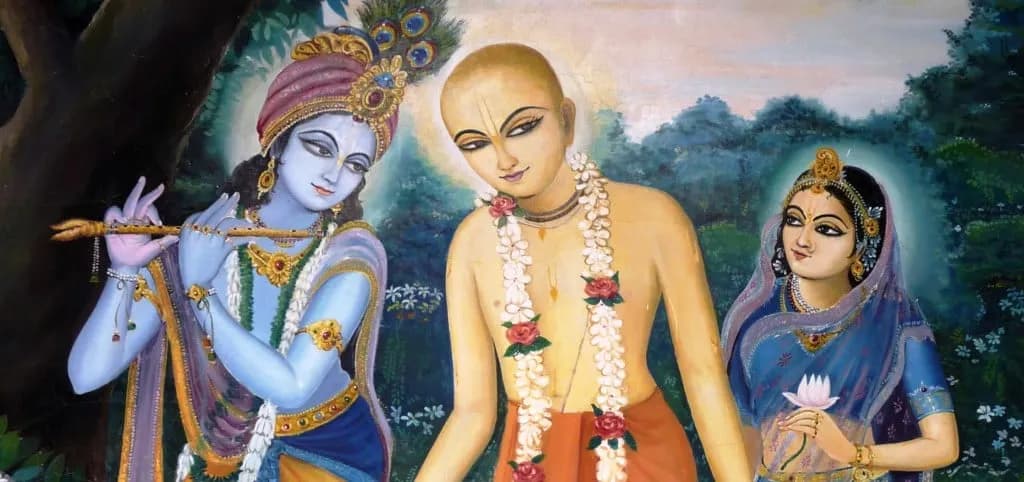
How can we clean the heart? Ceto-darpaṇa-marjanaṁ is not so easy. Who will clean the heart?
śṛṇvatāṁ sva-kathāḥ kṛṣṇaḥ
puṇya-śravaṇa-kīrtanaḥ
hṛdy antaḥ-stho hy abhadrāṇi
vidhunoti suhṛt satām
Śrīmad-Bhāgavatam 1.2.17
Śrī Kṛṣṇa, the Personality of Godhead, who is the Supersoul in everyone’s heart and the benefactor of the truthful devotee, cleanses desire for material enjoyment from the heart of the devotee who has developed the urge to hear His messages, which are in themselves virtuous when properly heard and chanted.
Kṛṣṇa’s glories should be heard from a mahā-bhāgavata who has a deep relation and attachment to Kṛṣṇa and the Vraja-devīs. By hearing from them, one’s heart will become clean. By hearing from ordinary people we will accrue a little sukṛti, and some faith or respect may come. They can help us to some extent, but the heart will never become cleansed. The love of a mahā-bhāgavata is so powerful that it can control even Kṛṣṇa Himself. The hari-kathā of such a realized personality has the ability to purify the heart. An ordinary person may try to clean the heart, which is compared here to a mirror (darpanam), but he doesn’t know the proper process. If a mirror is very dirty, one has to repeatedly clean it with liquid soap in order to be able to see one’s true reflection. The mahā-bhāgavata possesses and distributes kṛṣṇa-rasa and if one drinks that, one’s heart will become clean. Without kṛṣṇa-rasa, ceto-darpaṇa-marjanaṁ is not possible.
In the beginning there is a need for some faith by which one can develop some taste for sādhu-saṅga. And then by bhāgavata-śravana, chanting harināma, residing in the holy dhāma, honoring mahā-prasāda, and rendering service to Hari, Guru, and the Vaiṣṇavas, one’s heart will become clean. Without these elements it is not possible.
For the conditioned soul it is not enough to chant just once. Everyday one should chant:
hare kṛṣṇa hare kṛṣṇa kṛṣṇa kṛṣṇa hare hare
hare rāma hare rāma rāma rāma hare hare
By daily chanting together with Guru and Vaiṣṇavas, their transcendental power is able to manifest and thus cleanse the disciple’s heart. Svāmi Prabhupāda cared so much about his followers. Many people came to him and he engaged them all in chanting their 16 rounds together. In this way, how can māyā come? How will one’s heart not become clean? It is helpful to practice chanting together. Svāmi Prabhupāda followed and taught this practice. Mahāprabhu used to practice this as well at Śrīvāsa-aṅgana, for one, two, three hours, and then up to 24 hours a day. When Śrīla Svāmi Mahārāja was present, he used to practice this in the early morning. But who is kind to us and helping us now? Chanting harināma by oneself is difficult.
ekākī āmāra nāhi pāya bala harināma-saṅkīrtane
Alone, I do not have the strength to perform my harināma-saṅkīrtana.
Therefore we sing:
ohe! vaiṣṇava ṭhākura dayāra sāgara e dāse karuṇā kari
O worshipable Vaiṣṇava Ṭhākura! Ocean of mercy! Please be merciful upon this servant.
Sādhu-saṅga means that many sādhus gather together and perform nāma-saṅkīrtana. How to recognize a real sādhu? A person who does not rise during the brahma-muhūrta and chant his harināma and guru-mantra cannot be called a sādhu. Such people are not sādhus, they are svādhus.
If someone does not chant during niśānta-līlā, then he can chant for the entire day, but the result will not be the same. By practicing during the brahma-muhūrta realization will come. The brahma-muhūrta is not a good time for sleeping, talking, or enjoying. This time should be reserved for Kṛṣṇa, as well as the evening. At these times it is proper to chant harināma, stava-stutis, and different prayers, and hear hari-kathā.
Only by the mercy of the Guru-vārga will ceto-darpaṇa-marjanaṁ happen. Who cleans our hearts? We should call out to the Guru-vārga, to Nāma Prabhu, and to the sādhus. We do not know the process of cleaning ourselves. By chanting harināma in sādhu-saṅga, harināma will go inside and cleanse the heart. This process is very powerful.
There is a fine layer of desires covering the soul. Due to this covering, the conditioned soul and the Supreme Soul are separate from each other. This covering is very dark. Therefore the soul can not see the Supreme Soul, although they are very close to each other. The Supreme Soul is powerful and effulgent, and the soul has consciousness. How can material elements cover the soul’s consciousness? It seems impossible. When the sun rises it distributes its light everywhere—if not directly, then indirectly. In this way, everyone can understand that the sun has risen.
If the soul has consciousness, how can it be covered? This covering can be compared to clouds. Clouds contain water that the sun collected from everywhere. Due to no direct sunlight, the areas that are covered by these clouds are a little cooler and darker, but the sun itself has no relation to that darkness. The clouds between the sun and the earth’s surface are the cause of this darkness. The soul is independent and is therefore free to look either towards the light or the darkness. This is the nature of taṭasthā. The jīva is in the marginal position. On one side there is the eternal spiritual realm, and on the other, the temporary mundane world.
On top of the soul is a covering which is like a protective layer. As a peanut is protected by a fine red layer and a harder outer layer, the jīva is covered by a gross and subtle layer, which are not actually bad. The devotees also have subtle and gross bodies, but they are continuously using them in Kṛṣṇa’s service. A coconut is covered by a thick outer and hard inner layer. The body, which is given by Kṛṣṇa, can be very helpful for the jīva, although it will eventually be destroyed. Manaḥ (mind), buddhiḥ (intelligence), ahaṅkāraḥ (false ego), and cittaḥ (consciousness) are representations of Vāsudeva, Saṅkarṣaṇa, Pradyumna and Aniruddha. Kṛṣṇa’s catur-vyūha expansions help the jīvas from all four sides, but independent jīvas, who forgot that they are actually part and parcels of Kṛṣṇa, are busy satisfying themselves and other conditioned souls, neglecting their relationship with Kṛṣṇa.
How can the soul make a relationship with the Supreme Soul and get a continuous desire for His service? The conditioned souls use everything as they like, with the mood of a doer. It is important to know how and when this attitude will change. One can only get purified by the association of Guru and Vaiṣṇavas who are śuddha Vrajavasīs.
Va-ra-ja. Raja means dust, and va means very special. This refers to the very special foot dust of the Vraja-devīs. Our heart will be cleansed by anointing ourselves with the dust of the Vraja-devīs’ lotus feet.
Uddhava prayed:
vande nanda-vraja-strīṇāṁ
pāda-reṇum abhīkṣṇaśaḥ
yāsāṁ hari-kathodgītaṁ
punāti bhuvana-trayam
Śrīmad-Bhāgavatam 10.47.63
I forever pray to the dust of the lotus feet of the gopīs in Nandagaon. The hari-kathā emanating from their lotus lips in their separation from Kṛṣṇa purifies the entire universe.
The chanting of harināma with the mood of the Vrajavasīs, taught by Mahāprabhu, is called prema-nāma-sankīrtana. This sankīrtana is different from others because Mahāprabhu has distributed this prema.
Understanding the mood of Mahāprabhu, Śrīla Rūpa Gosvāmī wrote the following verse:
priyaḥ so ’yaṁ kṛṣṇaḥ sahacari kuru-kṣetra-militas
tathāhaṁ sā rādhā tad idam ubhayoḥ saṅgama-sukham
tathāpy antaḥ-khelan-madhura-muralī-pañcama-juṣe
mano me kālindī-pulina-vipināya spṛhayati
Caitanya-cāritāmṛta, Madhya-līlā 1.76
O sakhī, today at Kurukṣetra, I met My same prāṇa-priya, Kṛṣṇa. I am that same Rādhā and there is also happiness in Our meeting. But nonetheless, I deeply yearn for Vṛndāvana, for the kuñja on the bank of the Kālindī that is inundated by bliss as a result of Kṛṣṇa vibrating the fifth note on His playful Muralī.
During the Ratha-yātrā festival, Mahāprabhu had this mood of a paramour lover.
Svarūpa Dāmodara and Rūpa Gosvāmī both understood this mood and they explained and taught this in their writings. Furthermore, Mahāprabhu Himself spoke this Śikṣāṣṭakam to help us understand this. No other teachings will give parakīyā-bhakti. By following any line other than the one of Mahāprabhu, one will enter svakīyā-līlā.
Śrīla Bhaktivinoda Ṭhākura sang:
kevala mādhava pūjaye so ajñānī
rādhā-anādara koroi abhimāna
Those who worship Mādhava alone are ignorant and disrespectful to Śrīmati Rādhārānī and the maṇjarīs. They will never be able to enter Vraja-maṇḍala. Therefore, the meaning of ceto-darpaṇa-mārjanam is that when one becomes clean at heart, one can become a maidservant of Rādhārānī and understand this parakīyā mood.
Bhaktivinoda Ṭhākura prayed:
pālya-dāsī kari lalitā sundarī āmāre laiyā kabe
śrī rādhikā-pade kāle milāibe ajña-sevā samarpibe
By following this line, one’s heart will become clean, the blazing forest fire of material existence will be extinguished, and the moon rays of our good fortune will rise. Kṛṣṇa is most happy and pleased by somebody who follows the lotus feet of Śrīmati Rādhārānī and Her sakhīs. Then, samyak-kīrtana, complete kīrtana, becomes possible.
Bhaktivinoda Ṭhākura said:
vidhi-mārga-rata-jane svādhīnatā ratna-dāne
rāga-mārge karān praveśa
rāga-vaśavartī haiyā pārakīya bhāvāśraye
labhe jīva kṛṣṇa-premāveśa
To the person fixed in the regulative principles (niṣṭhā), the holy name gives the jewel of independence, placing him on the path of spontaneous devotion (rāgānuga-bhakti). That person, overcome by spontaneous attachment to the Lord, takes shelter of the parakīyā mood and goes on to become absorbed in love for Kṛṣṇa.
Independently, one cannot cross this vidhi-mārga, but by following Mahāprabhu’s line, one can attain anurāga, by which one will be able to serve without any awe and reverence. Then one will understand the parakīyā mood. Therefore Mahāprabhu spoke this Śikṣāṣṭakam. One should sincerely try to follow Mahāprabhu’s line and understand these eight prayers. One should try to understand Mahāprabhu’s moods and the highest goal, which one can attain by following Him.
The meaning of ceto-darpaṇa-mārjanam is not simply to clean the heart of the body. What benefit will be there by cleaning the body and mind? The body is made of five elements, and the mind is another subtle element, but the soul is beyond these material elements, and it also has a mind and senses. What help will the treatment of the body give to the soul? Some small help may be there, in the same way that a clean temple facilitates a good environment to engage in bhajana. But this body is not our permanent residence, and therefore the purity of the body and mind will also be temporary. Only treating the body and mind is not enough. One must attain svarūpa-siddhi, perfection of the soul. One must realize that the soul is a part and parcel of Kṛṣṇa. The way to develop our soul and establish a relationship with Kṛṣṇa in Vraja is to follow the parakīyā-parāmpara.
[CC-by-NDNC Bhakta Bandhav]