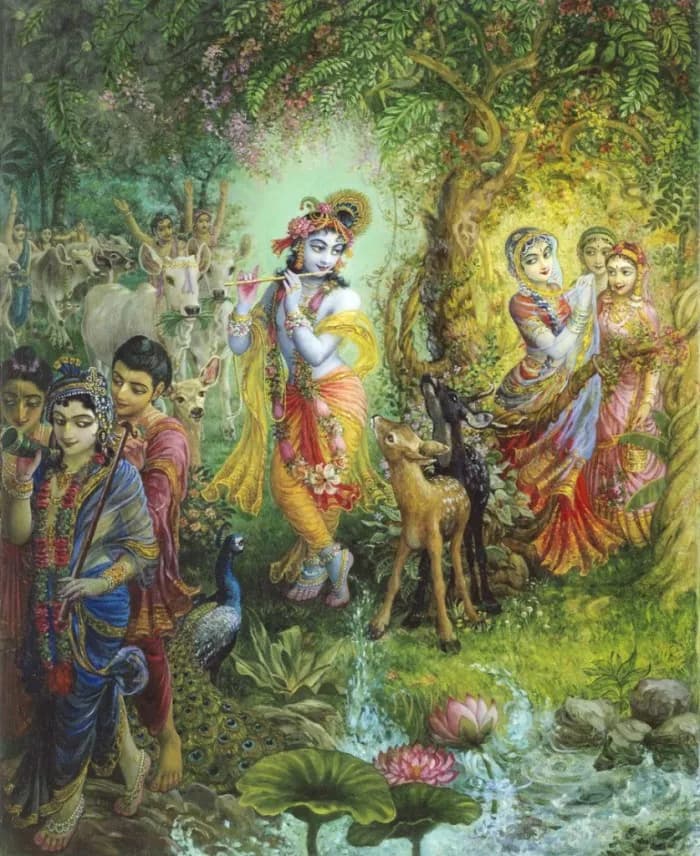
The gopīs collect the juice of many flowers with their heartfelt love. Their love shines in each and every drop of alaka decorating Śrīmatī Rādhārānī’s face. The color is like the reddish color of the rising and setting sun. This is the color of anurāga and decorates the head of Śrīmatī Rādhārānī.
Śrīla Raghunātha dāsa Gosvāmī is teaching how to develop eagerness for service to Śrīmatī Rādhikā’s lotus feet.
Every sādhaka needs to adopt certain rules and regulations, without which they cannot progress. This requires strong determination and dedication. We must vow to follow with a “do or die” attitude. “Let whatever else may happen happen, but I must do at least this much.” This is essential for the sādhaka. We should spend our days weeping and crying, praying for Rādhārānī’s service.
Dāsa Gosvāmī has glorified Rādhārānī’s lotus feet. He says: “There are many symbols on Rādhārānī’s lotus feet. Please, may I have some place nearby Her lotus feet. This is my prayer.”
He then expressed his desire to serve in Yāvaṭa, by cleaning Her drains and using his hair to dry them. In this way, one after another, he prayed to Śrīmatī Rādhārānī.
Now, he prays to place the bindi, red dot, on Rādhārānī’s forehead, and sindūra, a red line in the part of Her hair. Why is it there? An unmarried girl does not wear a bindi or sindūra. Those who are married wear a bindi and sindūra. What is the significance of this? It shows that we are giving this spot in the middle of our forehead to our beloved or spouse. And it is increasing their prestige and long life. But not only that. It gives them life energy and it shows our loyalty and love for them. It is a symbol of our love. Kṛṣṇa sees this. He thinks, “Oh, She is mine. She is showing Her love for Me. She has offered Herself to Me. She has put this bindi on Her forehead. It’s a symbol of Her love for Me.” He becomes so happy to see this. This is a great symbol of love.
Anyone who comes in our sampradāya of Caitanya Mahāprabhu, must wear tilaka. The forehead is considered the topmost part of the body. Wearing tilaka shows that we have offered ourselves to Kṛṣṇa. In Vraja, the gopīs all wear some sign on their forehead, showing their devotion to Kṛṣṇa. But it is also parakīya, not apparent to everyone. They wear a bindi, or a dot or small sign made from kastūrī. This is so fragrant and attractive—Kṛṣṇa becomes mesmerized by these symbols of their love. This bindi is the color of the rising sun tinged with saffron. It is the symbol of anurāga. The gopīs have offered their whole bodies to Kṛṣṇa, and they indicate this by wearing a bindi and sindūra.
Śrī Kṛṣṇa sees how the mañjarīs dress Rādhārānī, decorate Her forehead, and ornament Her, and it mesmerizes Him. The example is given. There is a handsome, qualified boy. And some girl wants to marry him. But he does not accept her. Then what happens? She becomes completely depressed. But if he accepts her, then she wears sindūra. This is showing: “He has accepted me.” And now she is free from all kinds of anxiety in her life.
In the same way the Lord is our all and all, our life and soul. There is no one aside from Him in our life. Everyone else is only for show, only fake. Then how can we bring Him in our life, and have Him accept us? What sādhana should we do? How will our fortune dawn? So many millions of lives have passed. Therefore, our Gosvāmīs wrote all these rules and regulations. Remember Him at this time, sing His kīrtana, glorify Him, during this time offer Him prasāda and accept His prasāda. In this way, by doing such practice, when our love completely goes to Him, and it becomes completely pure, without any spot, without any filth, and our life is offered to Him, then certainly He will accept us. This is the process. When he accepts us, our fortune dawns. Otherwise until that time we are unfortunate. We are lost. Those who accept Him become the most honorable, the most respectable. If someone has been accepted by the Lord, naturally they will become honored by the whole world, and worthy of that honor as well.
Those who are not accepted by the Lord—they are like old tattered cloth that no one wants, that no one even looks at. What is the respect given to such a person? Therefore, do we have a place at the Lord’s lotus feet or not? That person, who has such a place with Kṛṣṇa, is the most fortunate person.
The scriptures teach that if one serves the bhaktas and offers everything to them, then Bhagavān surrenders Himself to that person. So if someone becomes Rādhārānī’s maidservant and is always absorbed in serving Rādhārānī, Kṛṣṇa sees that and He becomes extremely pleased. He becomes filled with bliss and thinks: “Oh! How glorious this maidservant is!” Such a person who thus pleases Kṛṣṇa will obtain eternal bliss.
Those who are always bound within their thoughts of happiness in this world and service of the flesh, skin, and body—they cannot offer themselves in the Lord’s service. They are wandering around like lost orphans.
But if we use this same thing, this same body, in Kṛṣṇa’s service, than that same thing becomes so beautiful, so glorious, respected, and truly worthy of respect for the whole world. You body will become composed of transcendental ecstasy.
If someone serves Śrīmatī Rādhā Ṭhākurānī, and takes shelter of Her, then that is the mahā-mahā-auṣadhi, the greatest medicine for our life. If someone offers Her a flower, some sandal, some cloth, some ornament—if someone does anything, offers anything to Rādhārānī with love, then She is Kṛṣṇa-priyā, She is Kṛṣṇa’s dearmost beloved. She is Kārtikeśvarī, Urjeśvarī, Vrajeśvarī Śrīmatī Rādhārānī. She is worshiped, especially in the month of Kārtika. She is Dāmodara-priyā. She is worshiped in festivals in Her honor. Her service is the best kind of medicine and means to please Śrī Kṛṣṇa. It captures and completely annihilates any material sickness we have.
So if we can offer that sindūra to Rādhārānī, which is the aruṇa-varṇa, the color of pure love, anurāga, then Kṛṣṇa will be so pleased with us. And also mahābhāva-svarūpiṇī Rādhārānī will be so pleased with us. Kṛṣṇa will be controlled very easily by this. This is the glory and position of Rādhārānī’s maidservants.
When She has a chance for darśana of Kṛṣṇa for a few moments, then there is so much bliss. But Kṛṣṇa is always going to Rādhā-kuṇḍa to meet with Rādhārānī. They are always meeting there.
Sometimes Kṛṣṇa goes to Sakhī-sthalī, and Rūpa Mañjarī is searching for Him. Rūpa Mañjarī goes to that kuñja in Sakhī-sthalī, where He is with Candrāvalī, and she plays some trick to bring Kṛṣṇa out. She says: “Oh, a demon has come to Vraja! Oh please come and destroy this demon.” Then Kṛṣṇa says: “I must quickly go.” He understands her intent. He knows, His priyājī has so much separation. Kṛṣṇa says: “A demon has come. I am quickly coming.”
He tells Candrāvalī, “I will come back soon, don’t worry. I have to just go take care of this demon.”
Then Śyāma goes to Rādhā-kuṇḍa. When they start decorating Rādhā with sindūra, then He arrives. He cannot stay far away from Her.
Excerpted from the Bhakta Bandhav Publication “Śrī Vilāpa-Kusumāñjali”, Verse 26, The Kṛpā-kaṭākṣa Commentary
[CC-by-NDNC Bhakta Bandhav]