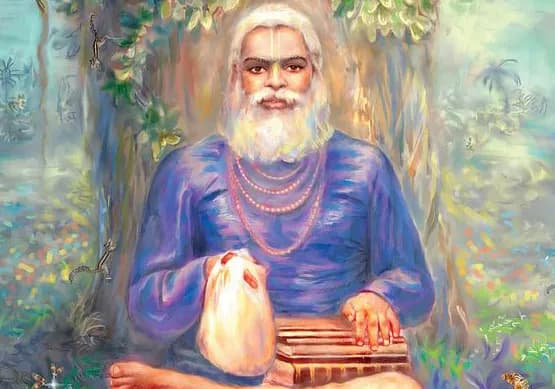
Among the great variety of philosophies, materialism (jada-vada) is very
widespread. Materialism is of two kinds:
- the philosophy of attaining material pleasures (jadananda-vada), and
- the philosophy of extinguishing (nirvana) material existence altogether (jada-nirvana-vada).
Now we will consider these two materialistic philosophies. First we will look at materialism in a general way.
All varieties of materialism say this: Inert matter exists, conscious life exists, and
everything is created from inert matter. Conscious life does not exist before inert
matter. Philosophies that teach about God are a useless waste of time. Inert matter
is eternal. If someone talks about "God", he is talking about a being who exists
only in his imagination. If any God exists one should search to find a higher
"God" that controls that God. God's existence has never been proved. In every
country and province are religious books describing God and describing the soul's
residence in a spiritual world. These books are the wild imaginations of various
rascals. They do not describe anything that truly exists. Therefore the words self
(atma) and consciousness (caitanya) refer only to certain aspects of matter.
Self and consciousness are created only by a variety of forward (anuloma) or backward
(viloma) interactions (samyoga) of material elements (jada-tattva). When the
interactions are forward, there is creation of self and consciousness. When the
interactions are backward, self and consciousness are again merged into matter. A
self s taking birth again and again in different forms, or reincarnation, is not
possible. Attaining liberation from matter by learning the truth about Brahman is
not possible either. Because the self is not different from matter, the self cannot
become liberated from matter. Therefore matter is the ultimate reality. All
existence is only a variety of aspects of matter. All atheists accept these ideas. One
group of atheists claims that each person's attainment of material pleasure is for
him the goal of life. Another group of atheists, understanding that material
pleasure is temporary and pathetic, searches after the happiness of nirvana
(cessation of material existence).
Now we will consider the philosophy of attaining material pleasures
(jadananda-vada). The philosophy of attaining material pleasures is of two kinds:
- the philosophy of selfish material pleasures (svartha-jadananda-vadI), and
- the philosophy of unselfish material pleasures (nihsvartha- jadananda-vadi).
They who follow the philosophy of selfish material pleasures think: "Neither
God, nor soul, nor afterlife, nor karmic reactions exist. Therefore, concerned only
for results visible in this world, let us spend our time in sense pleasures. We don t
need to waste our time performing useless religious activities." Because of bad
association and sinful deeds, this atheistic philosophy has existed in human
society from ancient times. However, this philosophy has never become
prominent among faithful, respectable people. Still, in different countries some
people have taken shelter of this idea and even written books propounding it. In
India the brahmana Carvaka, in China the atheist Yangchoo, in Greece the atheist
Leucippus, in Central Asia Sardanaplus, in Rome Lucretious, and many others in
many countries all wrote books propounding these ideas. Von Holback says that
one should perform philanthropic deeds to increase one's personal happiness. By
working to make others happy, one increases one's own happiness, and that is
good.
Trying to persuade the people in general, the authors of modern books
propounding the philosophy of material pleasure often talk about unselfish
material pleasure, or doing good, materially, to others. In India atheism existed
even in ancient days. With great erudition, one philosopher wrote a great
distortion of the Vedic teaching, a distortion called the Mimamsa-sutras, which
begin with the words "codana-laksano dharmah", a which replace God with an
"an abstract origin before which nothing existed" (apurva).
In Greece a philosopher named Democritus preached this philosophy also. He said that matter and void exist eternally. When these two meet, there is creation, and when they
are separated, there is destruction. Material elements are different only because
their atoms are of different sizes. Otherwise the elements are not different.
Knowledge is a sensation that comes when something within touches something
without. His philosophy holds that all existence is composed of atoms. In out
country also Kanada in his vaisesika philosophy also taught that the material
elements are composed of eternal atoms. However, the vaisesika philsophy is
different from Democritus atomic theory, for the vaisesika philosophy accepts the
eternal existence of both God and soul. In Greece Plato and Aristotle refused to
accept an eternal God as the only creator of the material world. Kanada's errors
are also seen in their views.
Gassendi accepted the existence of atoms, but concluded that God created the atoms. In France Diderot and Lamettrie preached the theory of unselfish material pleasure. The theory of unselfish material pleasure reached its high point in France s philosopher Comte, who was born in 1795 and died in 1857. His impure philosophy is called Positivism. It is inappropriately
named, for it accepts the existence of matter only, and nothing else. It claims:
Aside from sense knowledge there is no true knowledge. The mind is only a
special arrangement of material elements. In the final conclusion, no origin of all
existence can be described. Furthermore, there is no need to discover any origin
of the material world. There is no sign that any conscious creator of the material
world exists. The thinking mind should categorize things according to their
relationships, results, similarities, and dissimilarities. One should not accept the
existence of anything beyond matter. Belief in God is for children. Adults know
God is a myth. Discriminating between good and evil, one should act righteously.
One should try to do good to all human beings.
That is the philosophy of unselfish material pleasure. Thinking in this way one should act for the benefit of all human beings. One should imagine a female form and worship it. That form
is, of course, unreal. Still, by worshiping it one attains good character. The earth,
or the totality of material existence, is called the "Supreme Fetish", the land is
called the "Supreme Medium", and the primordial human nature is called the
"Supreme Being". A female form with an infant in her hands should be worshiped
morning, noon, and night. This imaginary female form, who is an amalgam of
one's mother, wife, and daughter, should be meditated and worshiped in the past,
present, and future. One should not seek any selfish benefit from these actions.
In England a philosopher named Mill taught a philosophy of sentimentalism that is
largely like Comte s philosophy of unselfish material pleasure. In this way
atheism, or secularism, attracted the minds of many youths in England. Mi l l ,
Lewis, Paine, Carlyle, Bentham, Combe, and other philosophers preached these
ideas. This philosophy is of two kinds. One kind was taught by Holyoake, who
kindly accepted God existence to some extent. The other kind was taught by
Bradlaugh, who was a thorough atheist.
The philosophy of selfish material pleasure and the philosophy of unselfish
material pleasure, although different in some ways, are both materialistic. When
one deeply thinks about the ideas of all these materialistic philosophers, one will
see that materialism is useless and untenable. When one simply glances at them
with the eyes of pure spiritual logic, one will reject these ideas as pathetic and
untenable. Even ordinary material logic will show these ideas are untenable and
should be rejected. This is seen in the following ways:
- The philosophy of materialism searches for a single principle that is the root
of all existence. This is a great folly. If one thinks the material atoms are eternal,
the void is eternal, the relation between the void and the material elements is
inconceivable, and the powers, qualities, and actions of the material atoms are also
eternal, and all these things are eternal and beginning-less, then he cannot accept
that the material world was ever created. A person who accepts these ideas cannot
reduce the material world to a single underlying principle. He must accept the
simultaneous existence of many principles. What is time> That he has no power
to say. In this way their attempt to f ind a single underlying principle that governs
the material world is only the wild babbling of a child. - The philosophy of Materialism is unnatural and unscientific. It is unnatural
because every nature has a cause. To assume that matter is eternal and is the cause
of consciousness, which appears only as a by-product of matter, is very illogical.
The presence of causes and effects is natural in the world of gross matter. Without
causes and effects the material world would not be as it is. The philosophy of
Materialism is unscientific because consciousness has the power to manipulate
and control inert matter. Therefore the idea that consciousness is merely a byproduct
of matter is fiercely opposed to true scientific thinking. - Consciousness is naturally superior to inert matter. Only fools say
consciousness is a by-product of matter. Professor Ferris has clearly explained all
this. - Can anyone prove that matter is eternal. Professor Tyndall has clearly
shown there is evidence to prove the eternity of matter. If someone claims that he
has looked eternally into the past and eternally into the future and he has seen
that matter is eternal, no one should believe him. - Buchner and Molescott claim that matter is eternal. That is an imagination
that exists only in their heads. If in the course of time matter ceases to exist, their
ideas will become lies. - Comte writes: "We should not try to discover the origin or the conclusion
of the material world. That attempt only childish curiosity." However, because the
living entity is by nature conscious, he naturally curious to know these things.
The living entity cannot perform a funeral rite to celebrate the death of his own
natural curiosity. The search for causes and effects is the mother of all true
knowledge. If Comte's idea is accepted, human intelligence will be destroyed in a
few days. Of that there is no doubt. Then human beings will all become stunted,
numbed, and unthinking. - No one has ever seen human consciousness created from dull material elements. Only fools believe this will ever happen. In the book I hold in my hand, a history book describing three thousand years of human history, no one has ever seen an human being spontaneously manifested from inert matter. If human life is manifest from the spontaneous interactions of material elements, then in the course of all those years at least one human being would have been spontaneously manifested from inert matter .
- The graceful and harmonious arrangement of human beings, animals, trees,
and other living entities in this world points to a creator and controller. In this
way it is seen that there must be a conscious supreme creator.
In these many ways the philosophy of Materialism is refuted even by ordinary
logic. Only very unfortunate people accept the ideas of Materialism. They have no
idea of spiritual happiness. Their desires are very petty. The philosophy of
material extinction (nirvana) will be discussed later in this book...
Excerpted from Tattva-viveka of Srila Bhaktivinoda Thakura, Text 8