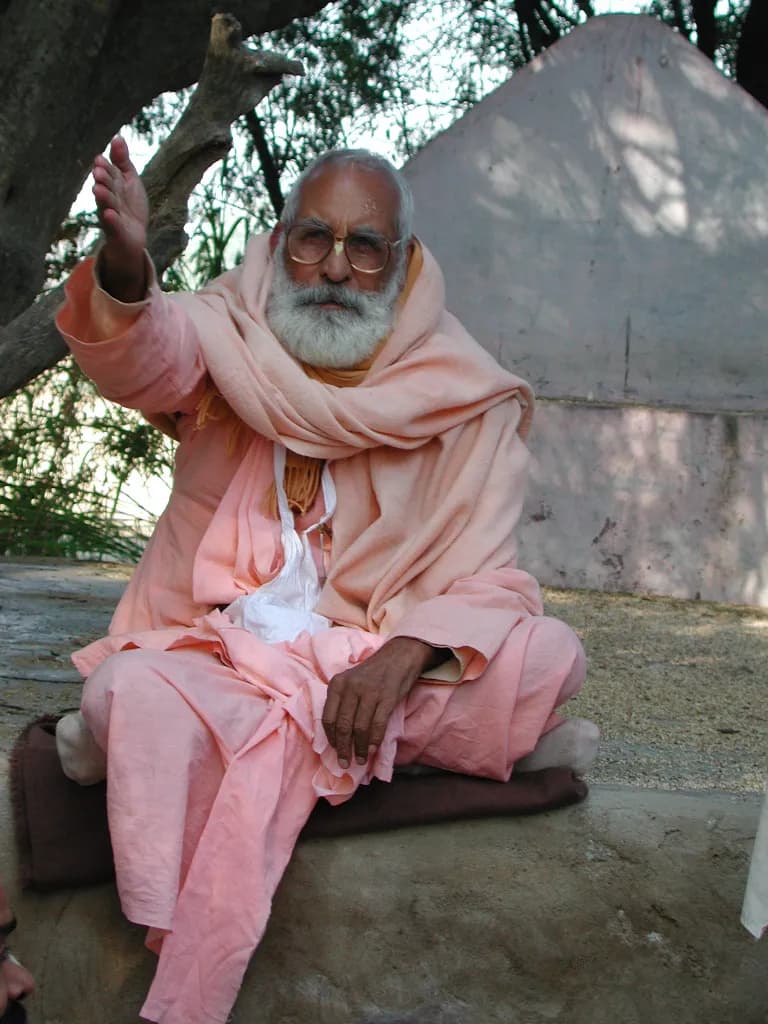
Śrīla Gurudeva: First, you should attain the lotus feet of Kṛṣṇa by chanting brahma-gāyatrī. After some time, it will be transferred to kāma-gāyatrī. First is this (the brahma-gāyatrī) and the last is that (the kāma-gāyatrī). After that is the mantra:
aim gurave namaḥHas your Gurudeva given you both this mantra? Devotee: Yes. Śrīla Gurudeva: You should think, “I am dedicating myself at the lotus feet of my spiritual master.” Who is he? This is mentioned in the second mantra. Gāyatrī means three parts.
oṁ bhūr bhūvaḥ svaḥ tat savitur varenyam bhargo devasya dhimahi dhiyo yo nah pracodayatThe guru-gāyatrī comes after the guru-mantra.
aim gurave namaḥThis is the first mantra to Śrī Guru. And then:
aim gurudevaya vidmahe krsnanandaya dhimahi tan no guruh pracodayatWho is guru? He is always worshiping Kṛṣṇa and Rādhikā. He is always making Him happy—krsnanandaya dhimahi. He gives ānanda, pleasure to Kṛṣṇa. Krsnanandaya means he is always serving and pleasing Kṛṣṇa. Who serves? Śrīmatī Rādhikā and the lady devotees like the gopīs. Only Śrī Caitanya Mahāprabhu has accepted this form of worship as the topmost. Nityānanda Prabhu, Baladeva Prabhu is akhaṇḍa-guru-tattva. And, the gurus now are the part and parcel of Nityānanda Prabhu. So, we should think of Śrī Guru as sākṣāt dharitvena. This should be applied to śikṣā-guru and dīkṣā-guru, both. While chanting these mantras, you should think, “So, he should manifest in my heart. He should manifest in both his forms.” Looking towards a devotee who has a body like us, we say, “He is my guru.” But really guru has no material body although the body changes. So, we will have to pray to him that “You should show me how you are. You should show how you serve Rādhā and Kṛṣṇa. This should come in my heart—pracodayat.” Pracodayat means pra-co-udayat. The disciple prays to his Gurudeva that, “You should manifest yourself in my heart.” Then:
klim gauraya svāhāWhile chanting this mantra, the disciple prays, “I am offering myself at the lotus feet of Śrī Gaurāṅga Mahāprabhu who is really Kṛṣṇa Himself but having the mood and beauty of His beloved, Śrīmatī Rādhikā. And He is so magnanimous. He has so much causeless mercy—more than even Kṛṣṇa.” Why? Because Rādhā’s mercy and Kṛṣṇa’s mercy have combined in Śrī Caitanya Mahāprabhu. Hence, you should pray, “So, I am offering myself at the lotus feet of Śrī Caitanya Mahāprabhu.”
klim caitanyaya vidmaheThe devotee prays, “I know He is Kṛṣṇa; He is surely Kṛṣṇa. Taking the beauty and mood of Śrīmatī Rādhikā, Kṛṣṇa has become Caitanya Mahāprabhu. He is distributing Caitanya, consciousness.” He is giving knowledge of one’s spiritual identity. He says, “You are a servant of Kṛṣṇa. You are a maidservant of Śrīmatī Rādhikā.” So, His mercy is for everyone without any cause. He is nourishing all.
caitanyaya vidmahe visvambharaya dhimahiViśvambhara means One who nourishes the whole world. He nourishes those who are in this world by giving love and affection. So, He should be worshiped. Śrī Caitanya Mahāprabhu is Kṛṣṇa Himself. You should realize this. Otherwise, you will only imagine. He should be understood i.e. you should realize how He is, who He is, what His teachings are, how He manifested, and how He nourishes all in their Kṛṣṇa consciousness. Then, you should chant the Kṛṣṇa (Gopāla) mantra. While chanting the Kṛṣṇa-mantra, you should pray, “I am dedicating myself at the lotus feet of Kṛṣṇa. He is Madana-mohana.” Kṛṣṇa is Madana-mohana; He is very beautiful. If you will see towards this deity… So, klim means k-l-i-m in a cyclic order. K means Kṛṣṇa; L means hlādinī-śakti—Śrīmatī Rādhikā. I means the jīvas i.e. ourselves. The dot (m) is the relationship between Kṛṣṇa and Śrīmatī Rādhikā. So we should offer Kṛṣṇa with that relation. Without a relation, anything cannot be done. You share your relationship with each other as husband and wife. So you are living together. But if this relationship was not there, then everyone would criticize you. So if there is any relation, then service comes automatically. We can do anything for our son, father, and our near and dear ones. So what is that relation? It is gopī-jana-vallabhaya. What is the relation between the gopīs and Kṛṣṇa? You should think, “I want this relation. I am tying myself with Kṛṣṇa and giving everything including my heart at the lotus feet of Kṛṣṇa.” So, “svāhā” means, “I am offering myself, my ātmā, body, mind, soul, and everything at the lotus feet of Kṛṣṇa.” And when we will be out of this māyika-body (material body), then we will be in our pure spiritual bodies. We cannot offer ourselves now because we have no realization of the ātmā. But try to realize. One day will come when you will offer yourself. svāhā means offering yourself. “Aha,” of svāhā means offering ghee into the fire. The fire is not merely fire; it means you are offering yourself to the lotus feet of Kṛṣṇa—who is Gopīnātha (controlled by the gopīs). So we are chanting like this. He should manifest. How should He manifest?
krsnaya govindaya gopī-jana-vallabhaya svāhāHere, Kṛṣṇa becomes Kāmadeva.
klim kamadevaya vidmahe puspa-banaya dhimahi tan no 'nangah pracodayatHere, Kṛṣṇa becomes Kāmadeva. Who is Kāmadeva? Kṛṣṇa dances with the gopīs and is controlled by the gopīs. And, He became so beautiful that everyone became attracted. So, this Kāmadeva is spoken of here. And then, Govinda means He who was dancing with the gopīs. He will be puspa-bana; He uses bows and arrows made of flowers. But these beautiful “arrows” of Kṛṣṇa are His face, nose, lips, and vaṁśī (flute). The different limbs of His body are like a puspa-bana. These arrows will never come out. So He becomes gopa-Govinda. He has become Gopī-jana-vallabha; this form is one of His highest attractive forms. He becomes a cowherd boy. He appeared before the gopīs after He had disappeared from their vision. He came in the form of Kāmadeva, anaṅga. Thus, while chanting this mantra, He should manifest like how He manifested Himself before the gopīs. If a little of that beauty will enter your heart, then it will never come out. So, it is like a prayer, but it also describes the body of Kṛṣṇa. Thus, we should utter all these mantras in the same moods that I have spoken of. And:
Śrī-Kṛṣṇa-Caitanya Prabhu-Nityānanda Śrī-Advaita Gadādhara Śrīvasādi-Gaura-bhakta-vṛndaWithout the help of pañca-tattva, we cannot deep into these moods because they have come to this world to give these moods. And, Hare Kṛṣṇa is our…Hare Kṛṣṇa means Rādhā-Kṛṣṇa. Hare means, “She who takes the heart of Kṛṣṇa.” Śrīmatī Rādhikā is Hara. The vocative case of Hara is Hare. Hare Kṛṣṇa means Rādhā-Kṛṣṇa. As for Hare Rāma, Hare means Rādhike and Rāma means Rādhā-ramaṇa. So, when we chant all these mantras, we should try to achieve these moods. And we should try to be in this line. When we chant the gopāla-mantra or the Kāmadeva-mantra, we will think that “We are in Vṛndāvana on the bank of the Yamunā where the peacocks are dancing. All kinds of flowers are blossoming. Rādhā-Kṛṣṇa are sitting underneath a very beautiful kadamba tree on a very good siṁhāsana (golden throne). They are so beautiful. I am so beautiful like the gopīs. My age is very little.” But, you should not think of yourself as a man. If you will think like this, then you cannot serve Śrīmatī Rādhikā. So, you should think and meditate like this while facing east. You should chant all the mantras. And if you have so much time, you can chant the gopāla-mantra and kāma-gāyatrī-mantra for one hour. You can chant 108 times on your beads. Devotee: Gopāla-mantra and kāma-gāyatrī? Śrīla Gurudeva: Yes. Think of yourself like this. We cannot serve while being in this form. So we should think, “I am very beautiful and qualified like the gopīs.” After some time, I will tell more. Devotee: One round like this per day? Śrīla Gurudeva: If you like, if you have time, then you can chant because you may have so many duties. But I think that you should try to make more time for Kṛṣṇa consciousness. You must spend more time hearing, reading, and remembering.
21 May 1996 Radlett U.K. [CC-by-NDNC Bhakta Bandhav]